Beyond Low Float, High FDV: What Better Token Launches Look Like

Josh Riezman
Chief Legal & Strategy Officer

Slater Santer
Research Analyst

Josh Riezman
Chief Legal & Strategy Officer
Slater Santer
Research Analyst
The reality of low float high FDV tokens has been shown hundreds of times. A token that lists at a large fully diluted valuation with a small fraction of supply circulating can trade up briefly, but in aggregate, inevitably bleeds. However, we sought to understand more about the dynamics of this process, both for our clients and ourselves: whether float determines average return post-listing, if it has any correlation with FDV, and what a solution to this model could look like. In a collaboration between GSR's research and advisory teams, we mapped every listing on major exchanges since 2013, a first-of-its-kind dataset that covers more than 2,300 token launches.
What we’ve found has not been entirely positive. We tracked every token launch ever, meaning our dataset includes dead and delisted tokens, and thus these numbers are not flattered by survivorship. The median exchange listing trades below its launch price within 3 days, and down 50% within 90 days. Clearly, recent token launches have disappointed buyers. Why does the structure guarantee this, and what can better launches look like?
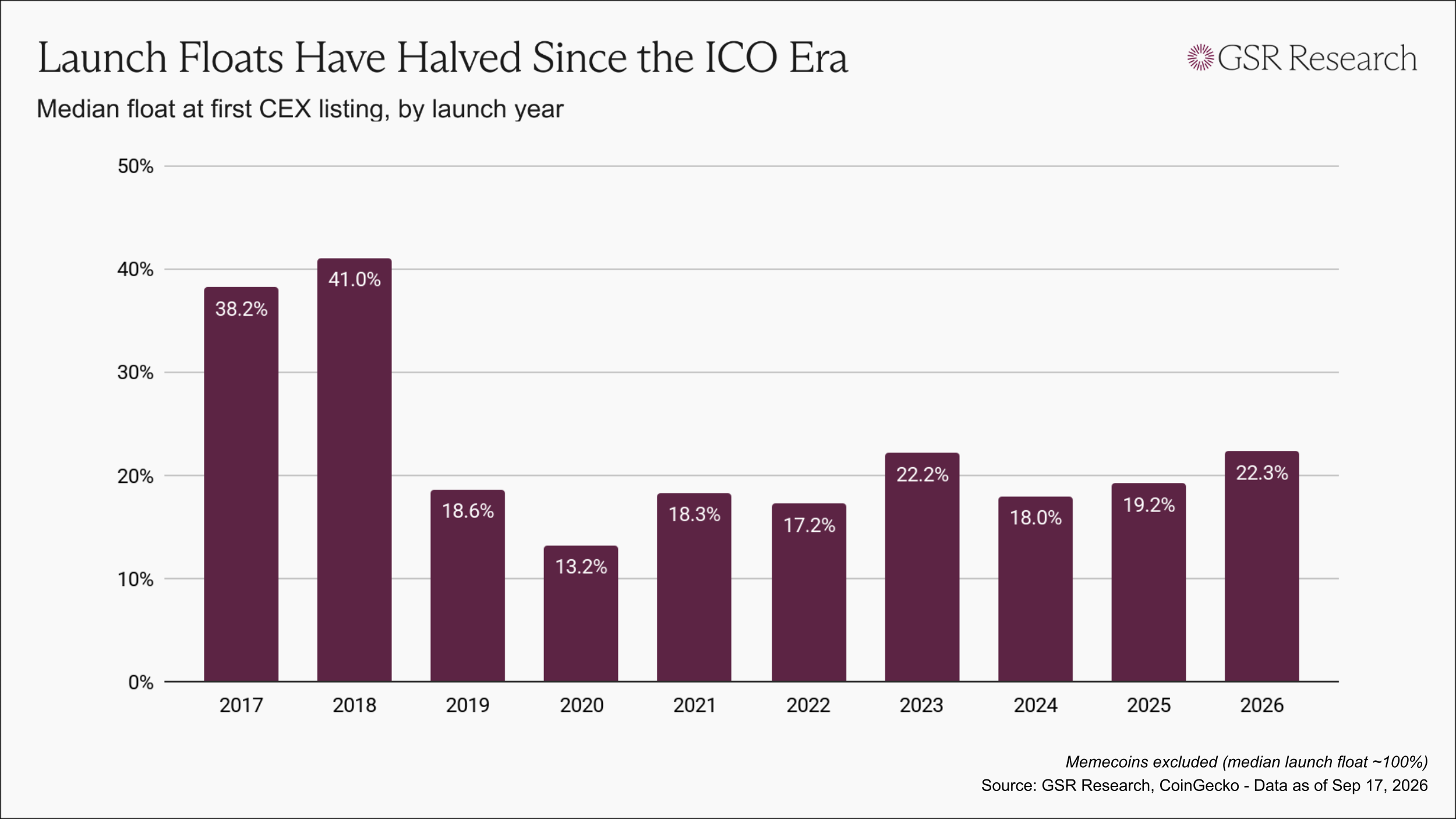
The ICO era had plenty of problems, but it put tokens in the public's hands. Median floats at first listing were 38 to 41% in 2017 and 2018. When stricter enforcement pushed fundraising private, the model inverted: venture rounds set the valuation, points and airdrop programs replaced public sales, and by 2020 the median float at listing had fallen to roughly 13%. It has recovered only partially since, sitting in the high teens to low 20s in most years.
However, the float number alone understates the problem, as float has to be judged against valuation. Releasing 5% of a sub $50M token has far less implications than releasing 5% of a billion-dollar one.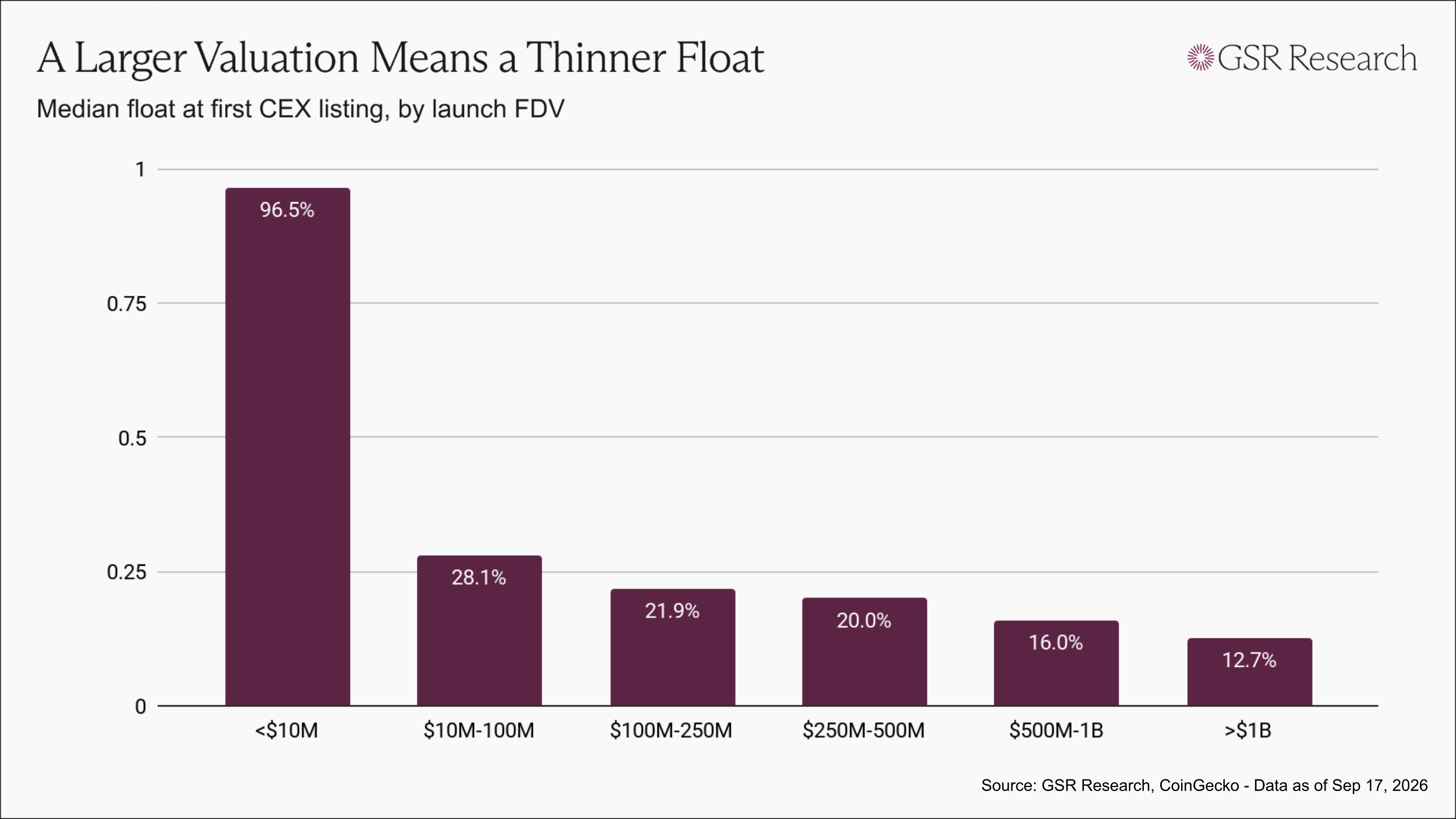
Median float at listing falls steadily as launch FDV rises: 97% for tokens under $10m, 28% between $10m and $100m, 16% between $500m and $1b, and 13% above $1b. The higher the mark, the thinner the float. Clearly, this not a coincidence, but the model our industry has settled on.
When only a small part of supply trades, modest demand marks up the value of the entire token. Everyone on the inside of the launch benefits on day 1. The venture investors are marked at the listing price, the team's holdings are valued at it, and the venue lists a headline asset. The only participant who does better when the token prices low is the buyer.
Then the vesting calendar arrives, and supply that was excluded from the float begins to reach the market on a published schedule, selling into prices that were discovered on a fraction of it. None of this requires bad intent from anyone. The structure guarantees that the incentives produce the same result on their own.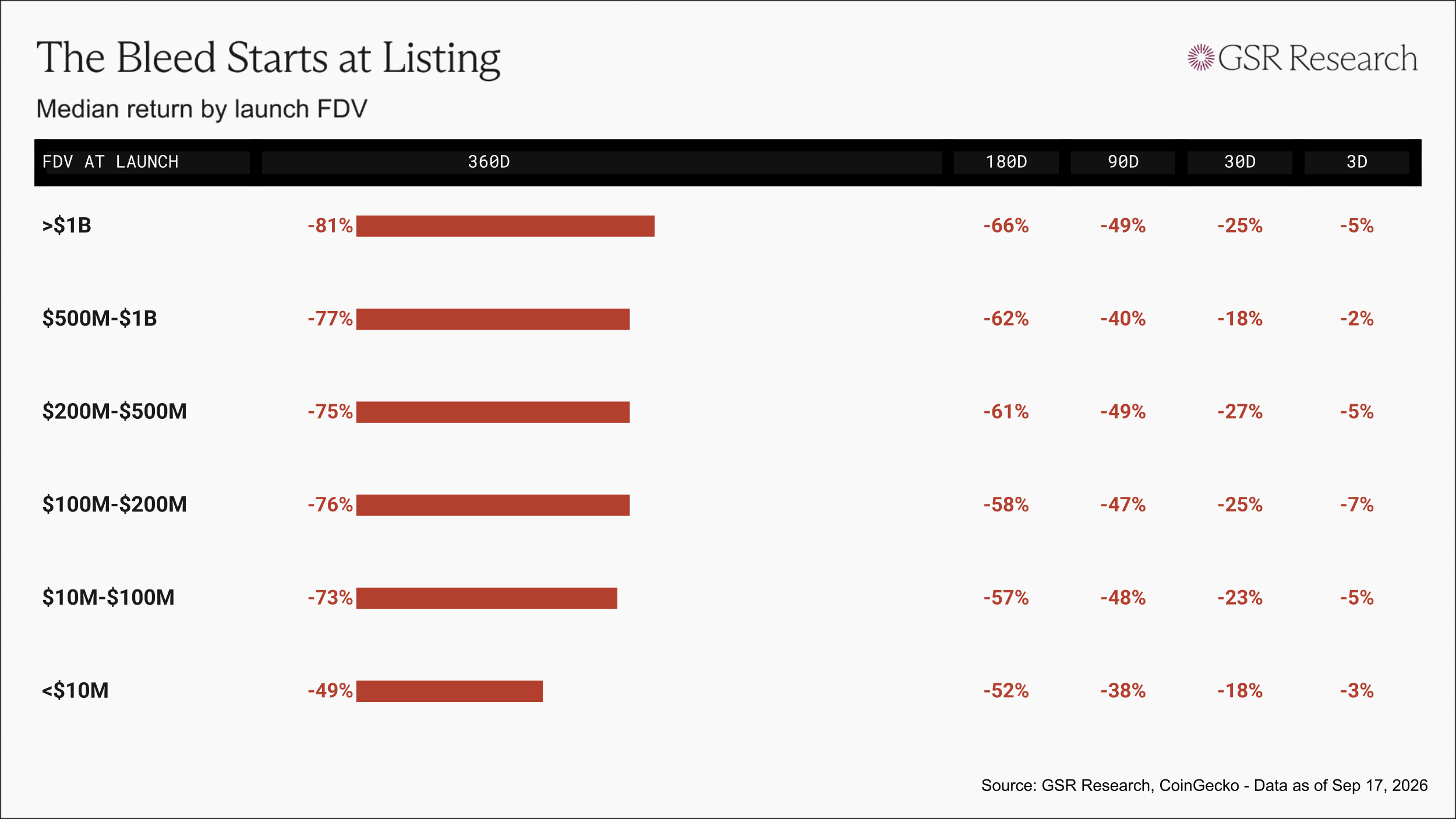
Across our dataset the median listing is below launch within 3 days, roughly a fifth to a quarter below it within a month, and near half by day 90. The median dollar invested in the cohort of projects that listed above $1b FDV sits at $0.19 360 days after launch.
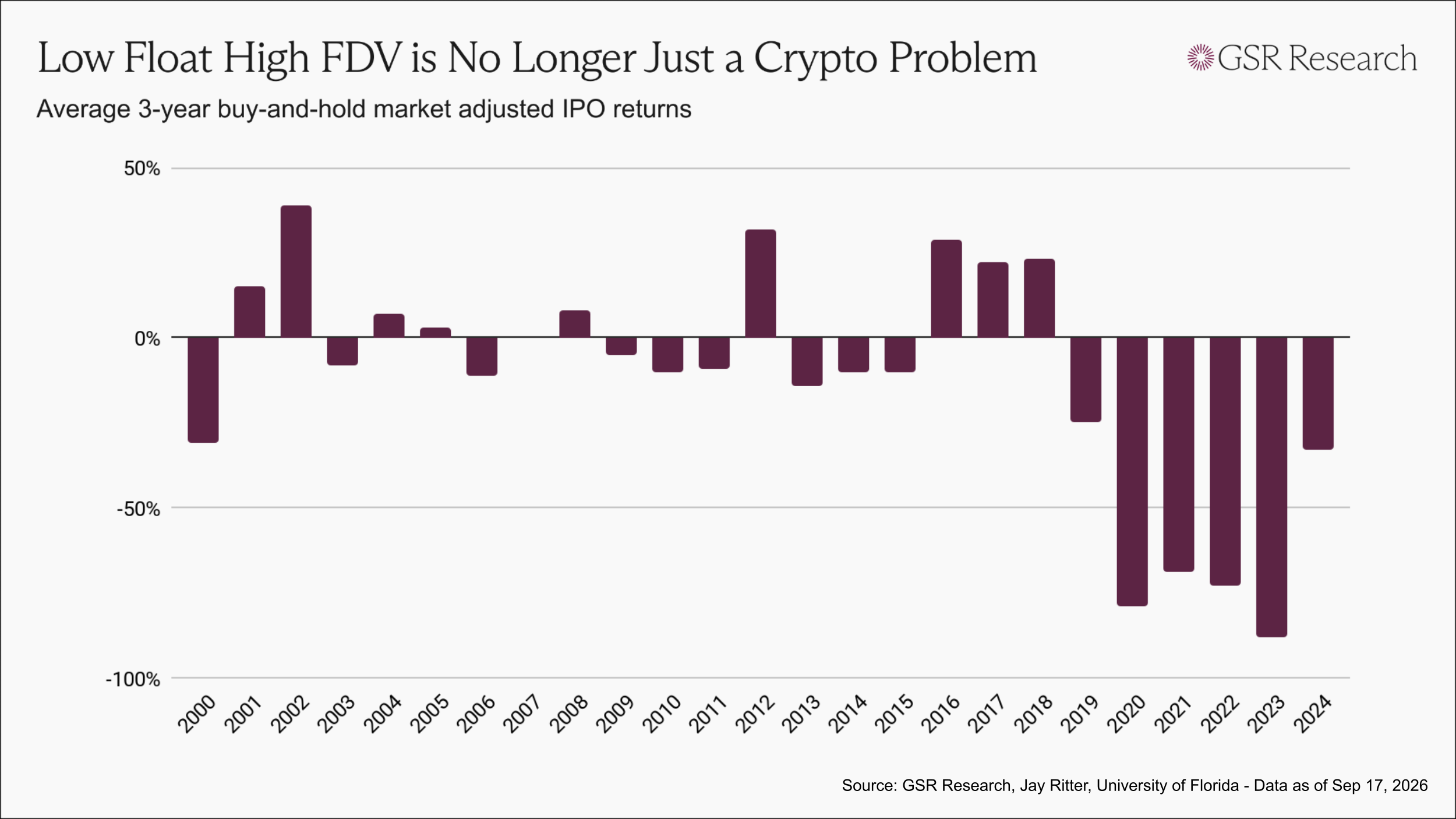
The low float high FDV model is often thought of as a problem confined to crypto. Recently however, public equity has drifted toward the same structure: companies like SpaceX stay private for a decade, insiders and late-stage funds accumulate at rising marks, and the eventual listing floats a small share of the company into public demand. On a 3-year buy-and-hold basis, IPO cohorts have underperformed the market in every year since 2019, with the recent cohorts among the worst on record.
Crypto's launch problem is the modern new-issue problem, with faster vesting and fewer disclosures.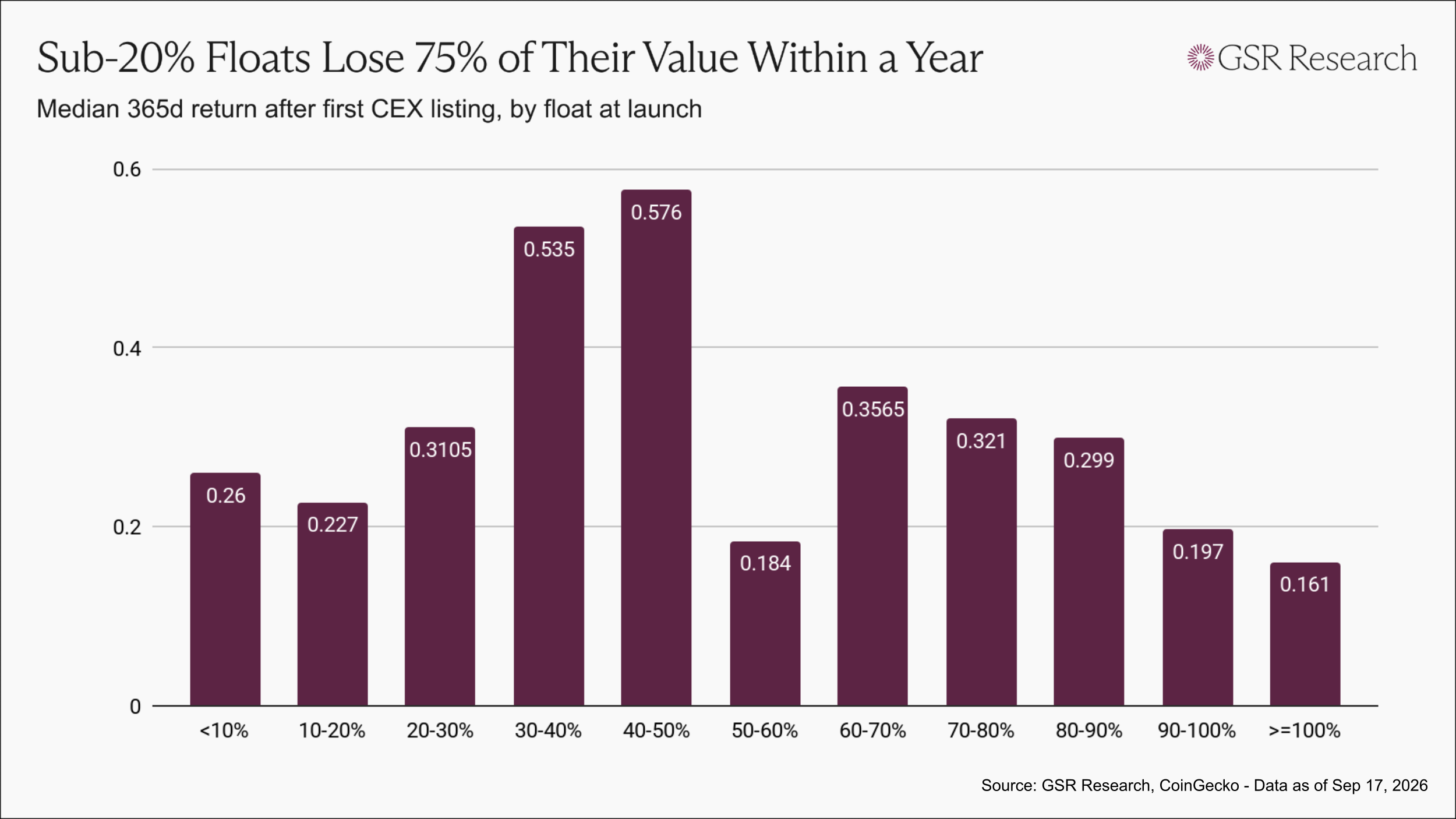
Within crypto, launches with floats under 20% retain roughly $0.23 to $0.26 on the dollar after a year. Launches that floated 30 to 50% retain ~$0.55, more than twice as much. The relationship breaks down at the top, where near-total float launches are predominantly low cap tokens and memecoins, but through the range where more hyped projects launch, floats that allow for greater distribution outperform floats designed for scarcity.
There is no single fix, and we are skeptical of anyone selling one. But the levers are visible from our seat across hundreds of launches.
First, price the launch so both holders and traders can win. The durable communities in this industry belong to the handful of assets the public could buy early and cheaply. Simply put, if you can enrich your holders, you will effortlessly develop a community. Selling the first public allocation at the top private mark inverts that, as it recruits holders into a position that can only disappoint them. It also drives away traders. A token that grinds lower from day one gives them nothing to work with: no two-way flow, no reason to take a short-term position, and no one on the bid when holders want to sell. The two groups are complementary. Traders supply the liquidity and price movement that holders need, and holders supply the base of demand that makes a market worth trading. A launch priced only for insiders loses both. Projects should be selling to their community earlier and lower, not exposing the public for the first time at the peak.
Second, float enough supply for honest price discovery. Meaningfully more than the 13 to 20% lows of 2020 to 2022, and judged against the valuation, not in isolation. For reference, a typical equity IPO floats around 30% and 50% is considered high; more than half at listing is rarely right for a major asset in crypto either. The goal is a float large enough that the day-1 price means something.
Finally, broaden who gets in, and when. Access is as important as float. We’ve seen the recent development and popularity of co-investment platforms that let smaller checks in on venture terms, reputation-gated allocations for real users, public sale venues, onchain auctions, and full-float fair launches. Each has tradeoffs. However all push in the right direction toward wider participation.
Additionally, the legal and compliance environment has significantly improved. In Europe, MiCA already permits issuers to offer tokens directly to the public. In the US, the CLARITY Act as drafted contemplates capped direct sales to retail. If it passes, the argument that securities law forces the private-accumulation model gets much weaker, and launch structure becomes a choice rather than a constraint.
Every launch is different. Stage, sector, jurisdiction, venue strategy, community, and vesting design all shape what a sensible float and valuation look like, and the answer for a $50m project is not the answer for a $5B one.
GSR works with token issuers, foundations, and investors across launch and listing advisory, including float sizing, valuation, distribution, and vesting design, alongside market making and liquidity provision on listed markets, and OTC execution and block trading for participants managing concentrated or vesting positions.
Our industry keeps relearning the same lesson. The projects that build lasting holder bases will be the ones that price their launches so the public can win, float enough supply for the price to be real, and let insiders do well the slow way, alongside their community rather than ahead of it.