GSR Weekly Update - July 27th, 2026
BTC: $64,779 (+0.4%) | ETH: $1,918 (+2.4%) | BTC Dom: 56.4% | Global Cap: $2.30T

Carlos Guzman
Research Analyst

Slater Santer
Research Analyst

BTC: $64,779 (+0.4%) | ETH: $1,918 (+2.4%) | BTC Dom: 56.4% | Global Cap: $2.30T
Carlos Guzman
Research Analyst
Slater Santer
Research Analyst
Last week Morpho publicly launched Midnight, its fixed-rate, fixed-term lending protocol. Morpho now sits second only to Aave among lending protocols with over $7B in TVL, making any new launch by the team a notable event. However, Midnight is particularly noteworthy in that it marks Morpho’s first attempt at tackling fixed-rate, fixed-term lending – a massive market in traditional finance that has nonetheless eluded DeFi to date. Fixed rates and defined maturities are the default structure of credit in traditional markets, yet onchain lending has developed in the opposite direction, with virtually all activity in floating-rate pools like Aave and Morpho Blue. Morpho is betting that now is the right time for onchain fixed-rate lending to finally take off.
Onchain lending started out much closer to Midnight's design. ETHLend launched in 2017 with borrowers posting loan requests specifying amount, duration, and rate, and lenders filling them individually. The liquidity needed to keep the protocol going never materialized, however: matching proved slow, requests sat unfilled for days, and the protocol had done only a few million dollars in volume before the 2018 bear market ended it. DeFi lending only took off with the introduction of pooled, variable rate lending. Compound launched towards the end of 2018 and dispensed with matching entirely, pooling all deposits of an asset, setting rates off utilization, and letting either side enter or exit at will. The introduction of cTokens further made deposits composable as collateral elsewhere in DeFi, facilitating liquidity formation. ETHLend's team recognized the virtues of this design in DeFi’s nascent stages and relaunched its own version as Aave in January 2020.
Other attempts at fixed-rate lending followed, but none managed to achieve real traction. Yield and Notional experimented with forgoing orderbooks in favor of an AMM-based design. However, this design exposed passive LPs to adverse selection, it had issues with slippage, and it led to greater liquidity fragmentation than pooled models. Other attempts included Term Finance, which experimented with a design using weekly auctions that would clear at a single rate. This handled pricing better than AMMs, but confined participants to scheduled windows and locked their capital for the auction whether or not it cleared. None of these managed to reach sufficient scale, and variable rate lending remains the predominant form of onchain credit.
The popularity of pooled, variable rate lending is partly explained by the type of demand that has existed onchain to date. DeFi's borrowers have primarily been leveraged traders who value instant liquidity over knowing their cost three months out, and are often trading in and out of positions across short time horizons. The institutions that prize predictable, longer horizon financing haven’t been present onchain, leaving fixed-rate protocols without a natural customer base with sufficient scale.
Midnight is thus making two bets. It’s betting that its design fixes the structural issues other protocols have suffered from. And it’s betting that now is the right time for fixed-rate demand to materialize onchain with institutional adoption beginning to pick up.
Midnight’s design has several features that address the issues previous attempts ran into. Offers do not lock capital: makers publish a price and size, and funds are pulled when an offer is taken using the protocol’s callback feature, so a lender can keep capital earning in a Morpho Blue market while quoting a fixed rate. Multi-market offers let one balance back quotes across many markets and maturities at once, so adding a maturity no longer splits liquidity. Rates come from prices makers choose rather than from a curve, giving them more tools to protect against adverse selection. Positions can be auto-rolled, removing the need to renew positions at maturity. And instead of bootstrapping from zero, a coming vault adapter will let the billions managed by Morpho's curators quote fixed rates directly.
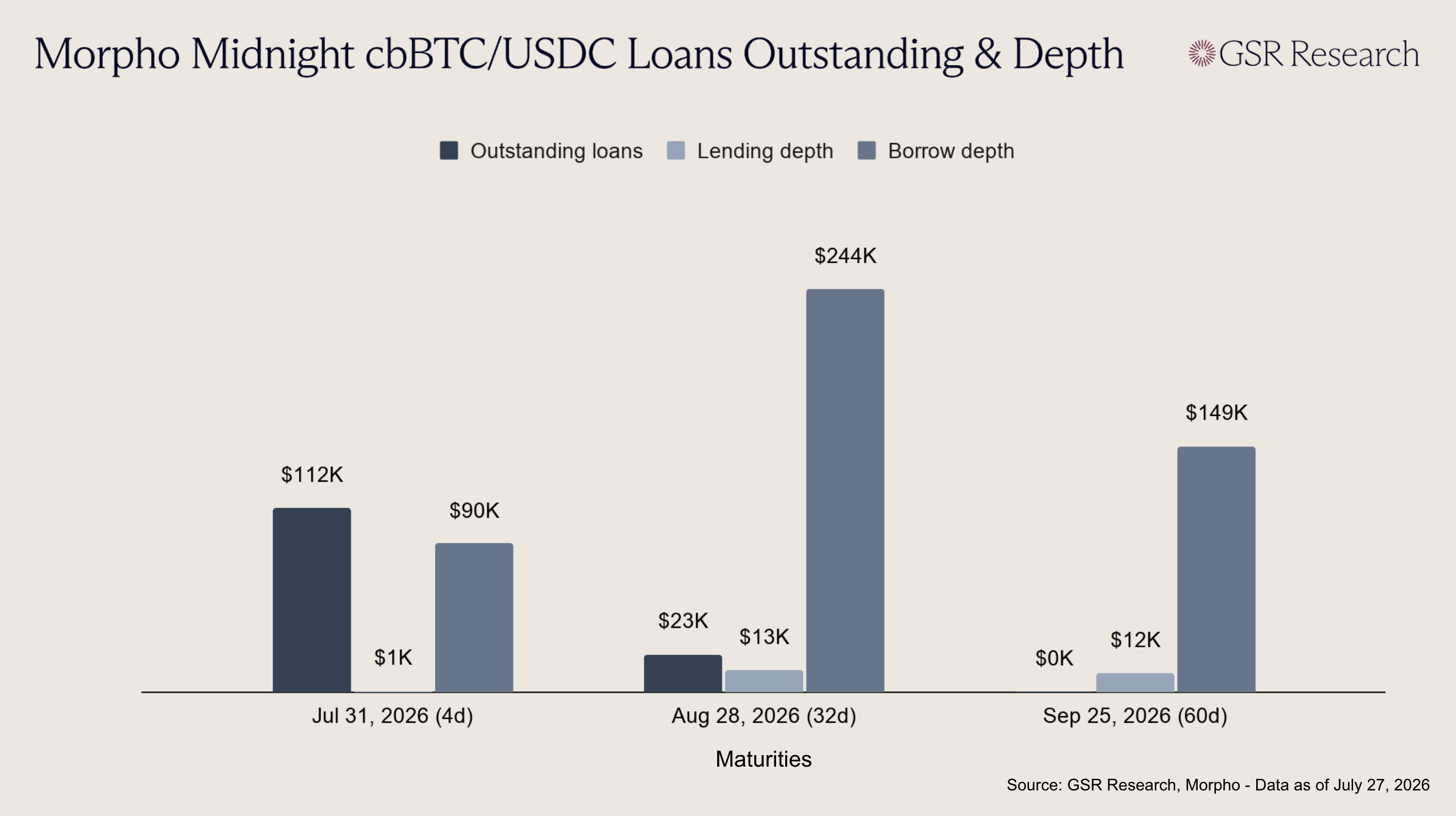
The rollout so far is deliberately narrow as Morpho prioritizes security and aims to battle test the code in production before scaling. Only one market (cbBTC/USDC) is live on Base and many of the key features like auto-rolling, callbacks, and the vault adapter are still to come. Usage and liquidity is thus still limited, with loans outstanding and liquidity depth yet to cross into the millions of dollars.
If Midnight succeeds, the implications across DeFi could be wide-ranging. DeFi has never had a term structure. Every onchain rate is effectively overnight money priced off a utilization formula, so nobody can observe what the market thinks three-month or twelve-month credit costs. A liquid Midnight curve would supply one, giving floating-rate products a market-set benchmark, and making rate derivatives possible since swaps, forward rate agreements, and the like all need a forward curve to price against. This could allow massive credit markets that have never come onchain to finally do so. Traditional debt capital markets measure in the hundreds of trillions of dollars, and the notional size of the associated derivatives markets are an order of magnitude greater. They could represent some of the most significant areas of growth for DeFi in the years to come. While Midnight is far from the first attempt at bringing these markets onchain, it might be the first attempt with the liquidity and distribution needed to succeed.
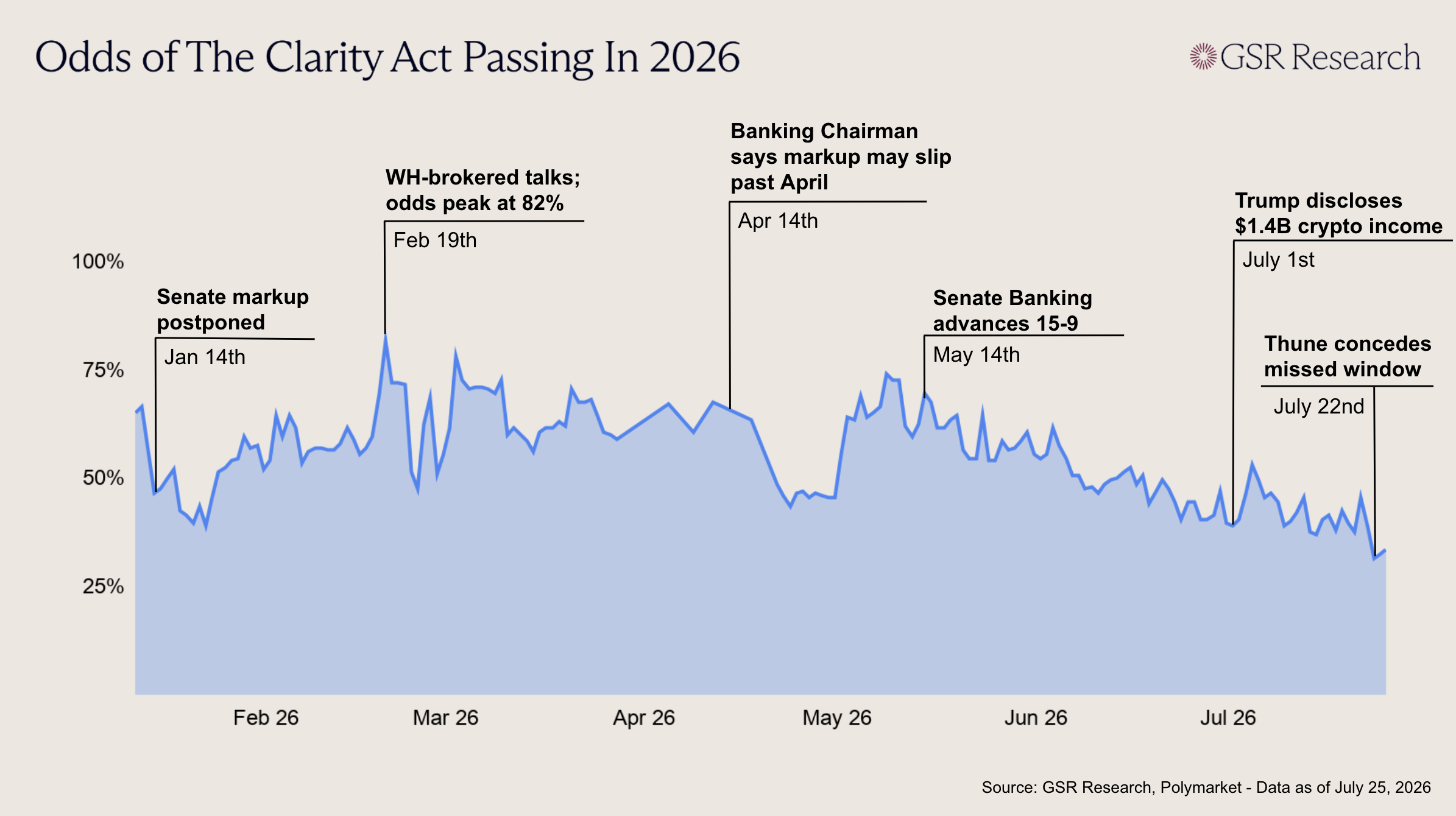
Senate Republicans released a 616-page combined draft of the Digital Asset Market Clarity Act last week, merging the Banking Committee's market structure text with the Agriculture Committee's intermediaries bill and adding a new ethics division, an expanded law enforcement title, and a set of GENIUS Act modifications. The reception has not been positive, with 7 Democratic negotiators claiming that the text fell short, Elizabeth Warren calling it dead on arrival, and Majority Leader John Thune recently conceding that he does not expect passage before the August recess.
For a bill the industry has treated as its top legislative priority for the past 2 years, the combined text was supposed to be the finish line. Instead, the stall exposes how little of the remaining fight is about crypto at all. The regulatory architecture is largely settled and broadly popular among the Senate. What remains unresolved is whether a sitting President who has made more than $1B from crypto in a single year can be meaningfully constrained by the same bill, and whether the Senate calendar leaves any time to find out.
The merged bill remains largely similar to the core architecture that passed 294-134 in the House last July. The CFTC gets primary spot market authority over digital commodities like Bitcoin and Ether, the SEC keeps investment contract assets, and tokens get a defined path to migrate from one identity to the other. The draft retains developer protections that shield noncustodial software developers from money transmitter registration, preserves self-custody rights, and carries over the GENIUS Act's stablecoin yield ban while still permitting activity-based rewards. It also adds tokenized securities guidance for the SEC, a CFTC registration and qualified custodian regime, and a law enforcement title aimed at elder fraud scams. Only 2 pieces of the package are genuinely new relative to the May committee draft, with the most contested by far being the ethics division.
The holdup, and the reason the ethics division exists at all, traces directly to the President's own crypto business. Trump's financial disclosure, released July 1st, showed more than $1.4B in crypto income in a single year, including $635M in royalties through CIC Digital, while a Wall Street Journal investigation showed that the Trump and Witkoff families' profited $1.2B in cash over 16 months plus $2.25B in paper gains. The most striking of the transactions was Abu Dhabi backed Aryam Investment 1 buying a 49% stake in World Liberty Financial for $500M in January, with $187M paid upfront to Trump controlled entities. Add the USD1 stablecoin, the TRUMP memecoin, American Bitcoin mining, and Trump Media's crypto treasury, and Democrats have spent the year arguing that a bill rewriting financial rules for crypto cannot be separated from a President personally profiting from the industry.
The new ethics division attempts to answer that critique by prohibiting the President, Vice President, members of Congress, federal judges, and their spouses from issuing or sponsoring a digital asset for consideration while in office, with a safe harbor for divestiture or blind trusts. Republicans called it the most powerful ethics language in US history. Democrats see 3 fatal design choices: enforcement sits exclusively with the DOJ, which Trump controls, while state attorneys general and private parties are barred from acting, the provisions do not reach the ways Trump has already made his money, and the division sunsets at noon on January 20th, 2029, expiring precisely when Trump leaves office. An ethics regime enforced only by Trump's own DOJ, blind to his existing ventures, and expiring the day he departs has led to the Democrats fiercely opposing the bill despite months of negotiation.
The bill has stalled as the Senate voting math continues to be unfavorable. Cloture requires 60 votes, Republicans hold 53 seats, Josh Hawley and Rand Paul are viewed as likely no votes, and Mitch McConnell has not voted since a June fall and hospitalization, leaving the effective Republican floor near 50 and the bill needing roughly 7 to 10 crossover Democrats. The 7 who have spent the past year negotiating, including Mark Warner, Ruben Gallego, and Raphael Warnock, are the same senators who rejected the new text, and Gallego and Angela Alsobrooks were the only 2 Democrats to support the bill in the May markup, which makes their defection decisive. Regrettably, the timeline to pass the bill is quickly running short. The Senate leaves for recess August 7th, a market structure package moving through regular order needs 2 cloture sequences and days of floor time, meaning July 30th is the practical deadline to begin. If Clarity misses the current window the bill will land in a September dominated by fighting over government funding and midterm politics, meaning the ideal window to pass it is quickly flying by.
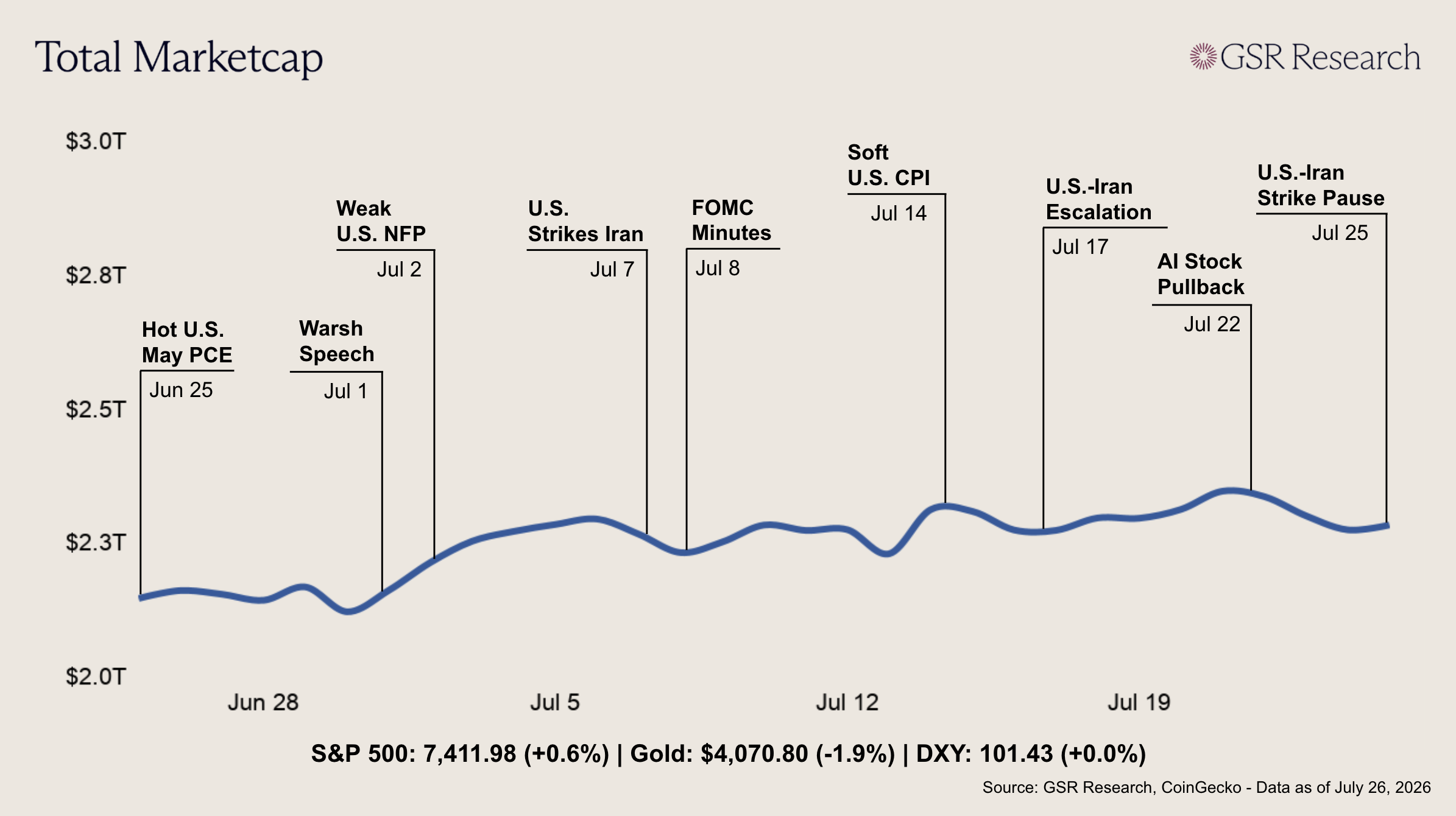
Crypto ended the week close to where it started, with total market value near $2.3 trillion. Bitcoin ran up to a one-month high around $67,000 in the middle of the week on renewed hopes for a US crypto law, then gave the gains back as tech stocks fell, oil jumped, and Washington rolled out new tariffs.
The week opened on a hopeful note. President Trump agreed to the ethics rules that had held up the CLARITY Act, the bill meant to set clearer rules for digital assets, and Treasury Secretary Scott Bessent said Congress was at the "one-yard line" and should pass it before the August recess. Bitcoin rose toward $67,000, and Coinbase shares jumped more than 10%.
The back half of the week went the other way. Alphabet and Tesla beat on sales but worried investors with the rising cost of building out AI, and their shares dropped sharply the next day, pulling the Nasdaq to its worst session in a month. Crypto fell with them. The war between the United States and Iran pushed oil back toward $100, and new US tariffs on 60 trading partners took effect on Friday, both reviving worries about inflation. Strong jobs data, including the fewest weekly jobless claims since 1969, lifted bond yields and put a Fed rate hike back on the table, with futures markets putting the odds near one in three for this week's meeting. The CLARITY rally faded as Democrats pushed back on the ethics terms. Oil eased over the weekend as the two sides paused their strikes, and Bitcoin recovered to about $65,000 by Monday. The Fed's decision comes Wednesday, with the CLARITY vote still in the balance.
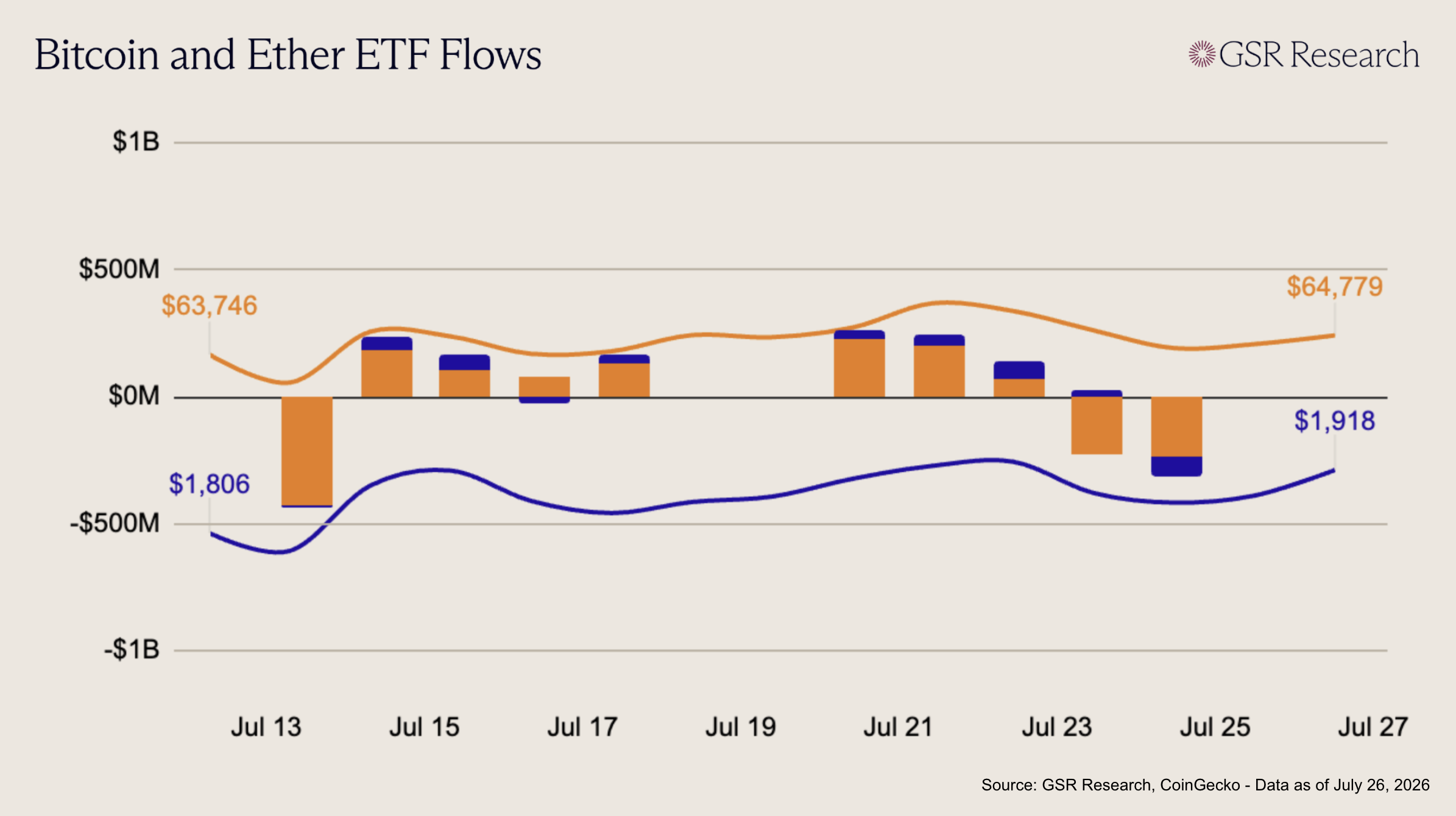
Spot Bitcoin ETFs finished the week slightly positive, but the path was choppy and the late-week reversal was meaningful. The week opened with two strong inflow sessions on Jul 20 (+$227M) and Jul 21 (+$203M), led by IBIT, FBTC, and ARKB. Momentum continued on Jul 22 (+$69M), but the tone weakened on Jul 23 as redemptions hit -$225M, followed by another large outflow on Jul 24 (-$240M). Across the five sessions, BTC ETFs gained roughly $34M, showing that demand is still present but remains unstable and vulnerable to abrupt reversals.
Ether ETFs were more constructive this week and finished meaningfully positive despite a sharp Friday pullback. The week started with steady inflows on Jul 20 (+$38M), Jul 21 (+$38M), and Jul 22 (+$73M), with ETHA doing most of the heavy lifting and FETH also contributing on Jul 22 and Jul 23. Inflows continued on Jul 23 (+$26M), but that strength gave way to a late-week reversal on Jul 24 (-$71M), driven primarily by ETHA and FETH. Even so, the week still closed with ETH ETFs up roughly $104M, suggesting that ETH demand was more durable than BTC’s.
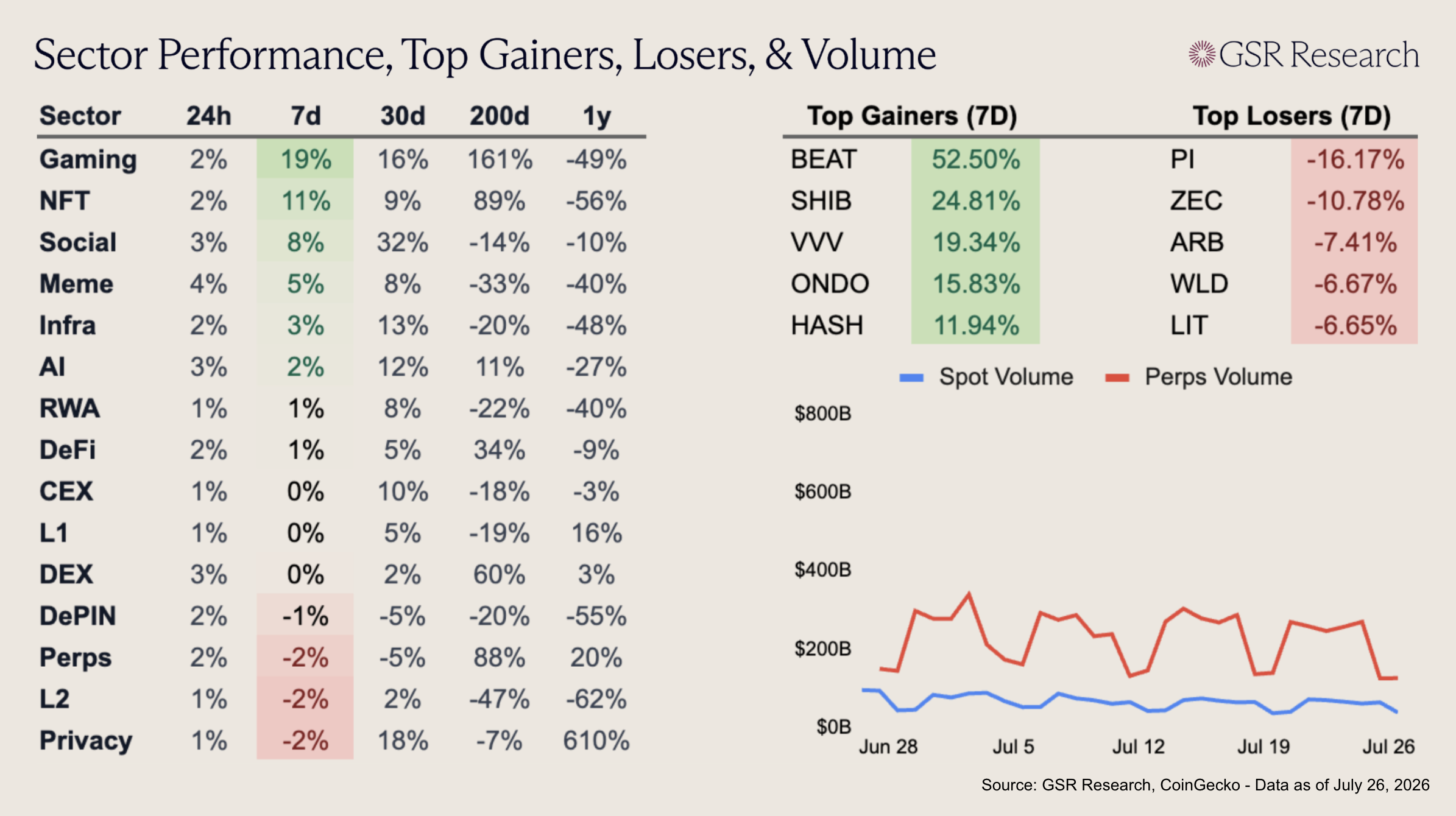
Alts had a broadly constructive week, with Gaming, NFT, and Social leading the board, up 19%, 11%, and 8%, respectively, and most sectors finishing in the green. Gaming was once again led by BEAT (+52.50%), with the token resuming its parabolic advance on continued revenue burn and aggressive futures positioning. NFT rose 11% as PENGU rallied with a late-July rotation into high-beta retail names, while Social's gain came from PUMP, which extended its run after trader Ansem disclosed a new position on Monday, sending the token to a two-month high. Meme added 5% as SHIB (+24.81%) surged into the weekend on heavy South Korean buying through Upbit and a squeeze through thin order books, with no announcement or development behind the move. VVV (+19.34%) climbed for a second straight week on its revenue-backed buyback and burn framework, ONDO (+15.83%) rallied as its expanded DTCC tokenization integration went live and FINRA approvals added fresh momentum, and HASH (+11.94%) rounded out the gainers, as the Provenance token grinded higher alongside the institutional RWA bid.
Downside was shallow, with DePIN, Perps, L2, and Privacy each off just 1 to 2%, and the loser board largely idiosyncratic. PI (-16.17%) set fresh all-time lows as monthly unlocks continued to swamp thin demand. ZEC (-10.78%) pulled back as traders de-risked into Monday's Ironwood activation, which remains an open question between recovery catalyst and sell-the-news event, pulling Privacy down 2% after a month near the top of the sector table. ARB (-7.41%) continued to give back its Robinhood Chain-driven rally, with the roughly $18m Ostium exploit and an upcoming token unlock adding pressure, while WLD (-6.67%) slipped even as its 43% emissions cut took effect on July 24, with the reduction removing under $1m of daily potential supply against roughly $190m in daily volume. LIT (-6.65%) fell for a third straight week, continuing to unwind the rally that followed its first revenue-funded burn and Robinhood Chain integration.
This material is provided by GSR (the “Firm”) solely for informational purposes. It is not intended to be advice or a recommendation to buy, sell or hold any investment mentioned. Investors should form their own views in relation to any proposed investment.
It is intended only for sophisticated, institutional investors and does not constitute an offer or commitment, a solicitation of an offer or commitment, or any advice or recommendation, to enter into or conclude any transaction (whether on the terms shown or otherwise), or to provide investment services in any state or country where such an offer or solicitation or provision would be illegal. The Firm is not and does not act as an advisor or fiduciary in providing this material.
This material is not an independent research report, and has not been prepared in accordance with any legal requirements by any regulator (including the FCA, FINRA or CFTC) designed to promote the independence of investment research.
This material is not independent of the Firm’s proprietary interests, which may conflict with the interests of any counterparty of the Firm. The Firm may trade investments discussed in this material for its own account, may trade contrary to the views expressed in this material, and may have positions in other related instruments. The Firm is not subject to any prohibition on dealing ahead of the dissemination of this material.
Information contained herein is based on sources considered to be reliable, but is not guaranteed to be accurate or complete. Any opinions or estimates expressed herein reflect a judgment made by the author(s) as of the date of publication, and are subject to change without notice. The Firm does not plan to update this information.
Trading and investing in digital assets involves significant risks including price volatility and illiquidity and may not be suitable for all investors. The Firm is not liable whatsoever for any direct or consequential loss arising from the use of this material. Copyright of this material belongs to GSR. Neither this material nor any copy thereof may be taken, reproduced or redistributed, directly or indirectly, without prior written permission of GSR.
Please see here for additional Regulatory Legal Notices relevant to US, UK and Singapore.