GSR Weekly Update - August 10th, 2026
BTC: $65,199 (+3.4%) | ETH: $1,923 (+3.9%) | BTC Dom: 56.7% | Global Cap: $2.31T

Carlos Guzman
Research Analyst

Slater Santer
Research Analyst

BTC: $65,199 (+3.4%) | ETH: $1,923 (+3.9%) | BTC Dom: 56.7% | Global Cap: $2.31T
Carlos Guzman
Research Analyst
Slater Santer
Research Analyst
Ethereum spent much of last week debating EIP-8363, a proposal to change how the network pays validators as more ETH is staked. The proposal, initially published as EIP-8361, did not get far. It was briefly considered for Ethereum’s Hegotá upgrade and then removed from the proposed-for-inclusion list, leaving it as a draft with no clear path into a near-term hard fork.
Still, the debate was useful. EIP-8363 put a real long-term issue on the table, and the pushback exposed two different disagreements about what Ethereum should do about it. One is substantive: would the proposal actually reduce centralization, or could it make the problem worse? The other is more strategic: even if the problem is real, is this the right time to change Ethereum’s monetary policy?
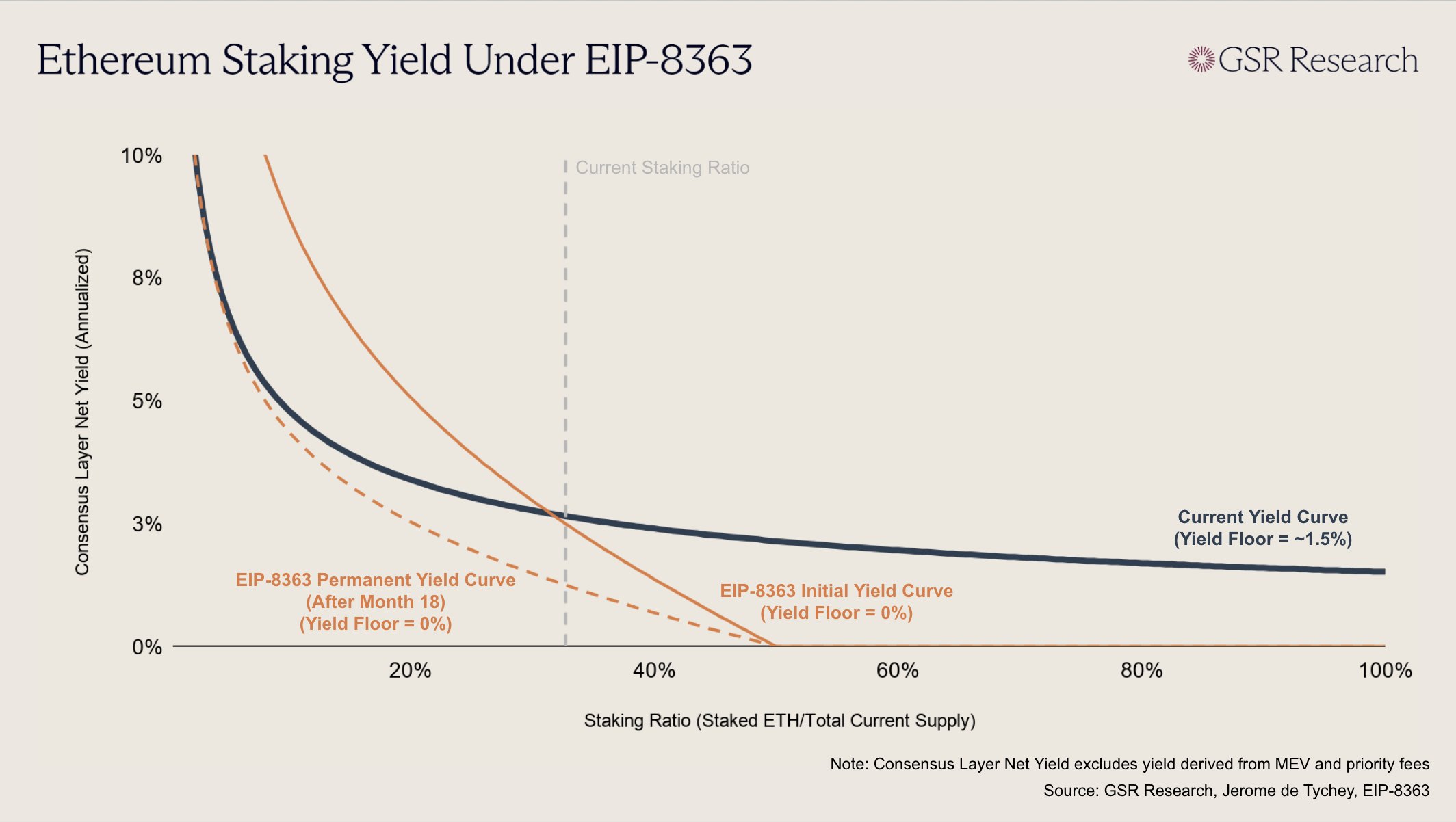
Ethereum currently pays validators partly through new ETH issuance. As more ETH is staked, the yield earned by each validator falls, though staking continues to offer a positive return even at very high staking ratios.
EIP-8363 would make that decline much steeper. It would burn a growing share of consensus-layer rewards as more ETH is staked, eventually offsetting 100% of consensus issuance once roughly half of all ETH is staked. At today’s staking ratio of around one-third of supply, consensus-layer yield would fall from roughly 2.6% to 1.2%. MEV and priority fees would remain, and the change would phase in over 18 months.
The concern is that the current model can gradually turn staking from an optional activity into something closer to a default. Holders who do not stake are diluted by new issuance, while stakers receive that issuance. As staking becomes easier through liquid staking tokens, exchanges and institutional custodians, more holders have an incentive to participate simply to avoid falling behind. The authors project the current system could take staking toward roughly 55% of supply by 2028.
That matters for centralization because most holders will not run their own validator. They will generally use the easiest and most liquid option, which tends to favor large exchanges and liquid staking protocols. As the staking ratio rises, more ETH can therefore accumulate behind a relatively small number of intermediaries. Large staking providers can then become increasingly difficult to punish if something goes wrong. Slashing or socially forking against a provider that represents a large share of ETH could impose losses on so many ordinary users that the threat becomes harder to carry out credibly. EIP-8363 tries to slow this process by reducing the incentive to keep adding stake once Ethereum already has ample economic security.
The main substantive criticism is that this mechanism may work differently once the economics of actual staking businesses are taken into account.
Large exchanges and custodians do not need staking to stand on its own. They can use it to retain customers, bundle it with custody, subsidize it with other revenue or accept lower margins because it supports a broader business. Solo stakers and smaller operators have much less flexibility. Their hardware, tax and operating costs remain even when protocol rewards fall.
A sharp cut in issuance could therefore remove the most price-sensitive participants first. If solo validators exit while large custodians continue offering staking, the validator set could become more concentrated even as the overall staking ratio falls. Pure staking protocols could face a similar problem because they have fewer ways to cross-subsidize lower rewards.
DeFi adds another complication. Liquid staking tokens are widely used as collateral, and their yield helps support the economics of borrowing and holding assets onchain. Lower staking rewards would reduce that yield and could make some DeFi positions less attractive.
This is ultimately an empirical question about who stops staking first. The proposal has a clear theory for why aggregate staking should fall. Its effect on the composition of the validator set is harder to know.
A second set of objections accepts more of the diagnosis and questions the priority.
Ethereum may eventually need to deal with an excessively high staking ratio. It is less clear that this is the most pressing issue today. Adoption, application growth and demand for blockspace remain more immediate constraints, and supply-side changes are unlikely to matter much if Ethereum does not keep expanding the economic activity taking place on the network.
There is also a cost to reopening issuance. Native yield has become part of the investment case for ETH, especially for institutions that can hold the asset, earn staking rewards and deploy it across onchain markets. Reducing that yield weakens one of ETH’s more distinctive features. More frequent monetary-policy changes can also make the current policy feel less durable, which raises the standard for intervention.
That concern extends to process. EIP-8363 appeared shortly before the Hegotá proposal deadline, leaving relatively little time for the broader community to work through a fairly consequential change. Much of the initial reaction focused on lower staking yield, while the underlying questions around over-staking, credible slashing and concentration received less attention.
The proposal may have moved too quickly for its own argument to land. The issue it raised is likely to return, and a future attempt would benefit from more time for public discussion, better evidence on how different types of stakers would respond, and broader agreement that the problem has become important enough to justify changing issuance.
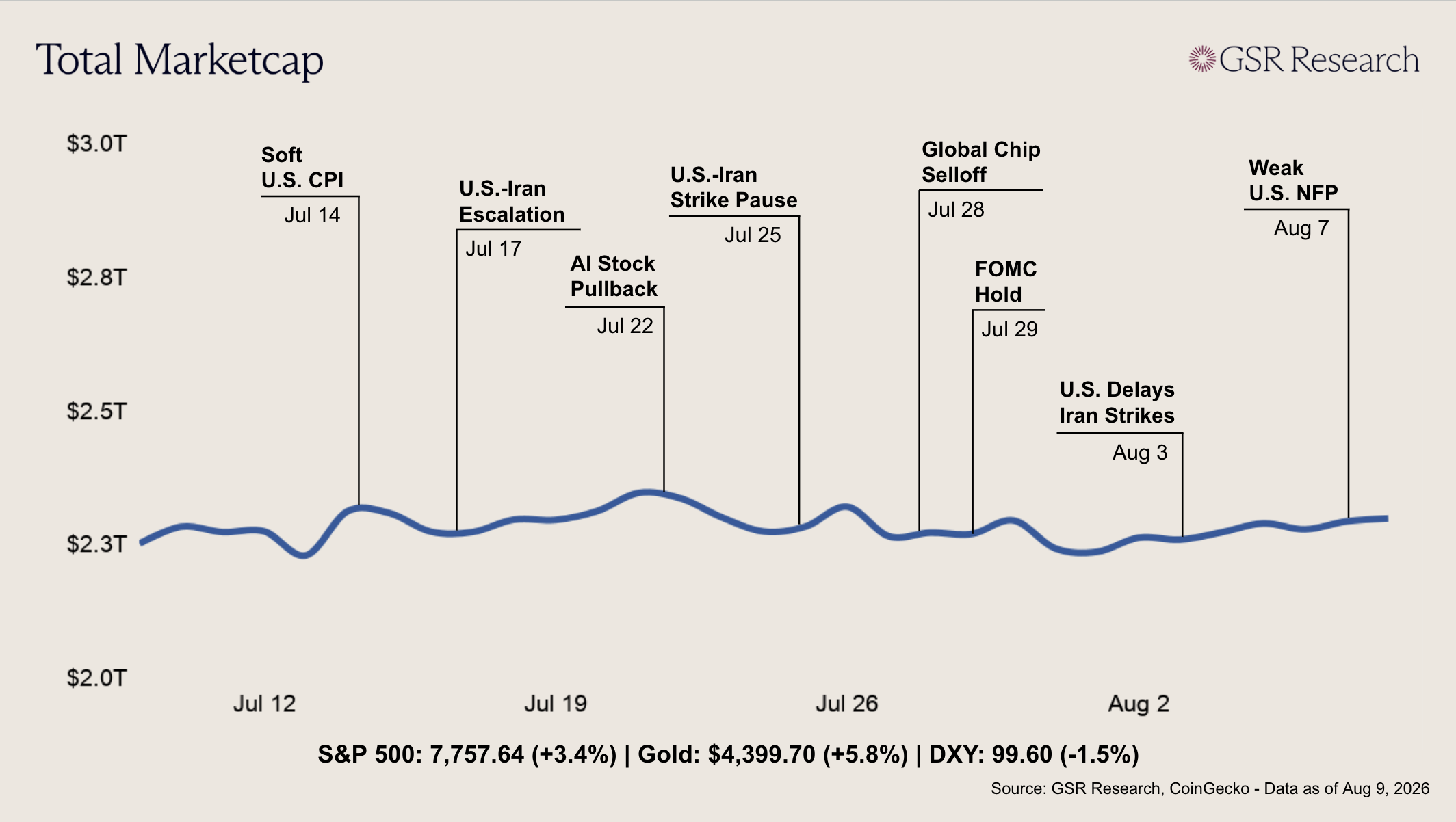
Crypto markets spent much of last week near recent levels as investors followed developments around Iran and the Strait of Hormuz. On Monday, President Trump delayed planned strikes on Iran, giving diplomacy more time and raising hopes for progress toward reopening the strait. Brent crude fell 4.7%, helping ease concerns that higher energy costs could keep inflation elevated. U.S. stocks rallied on the news, though Bitcoin remained close to $64,000 through much of the week.
Friday’s U.S. jobs report gave crypto a stronger push. Nonfarm payrolls fell by 23,000 in July, and employment growth for May and June was revised down by a combined 103,000. The weaker labor data reduced expectations for another Federal Reserve rate increase, with the market-implied probability of a September hike falling to around 44%. Treasury yields moved lower and Bitcoin climbed above $65,000, reaching its highest level in two weeks and holding those gains into Monday.
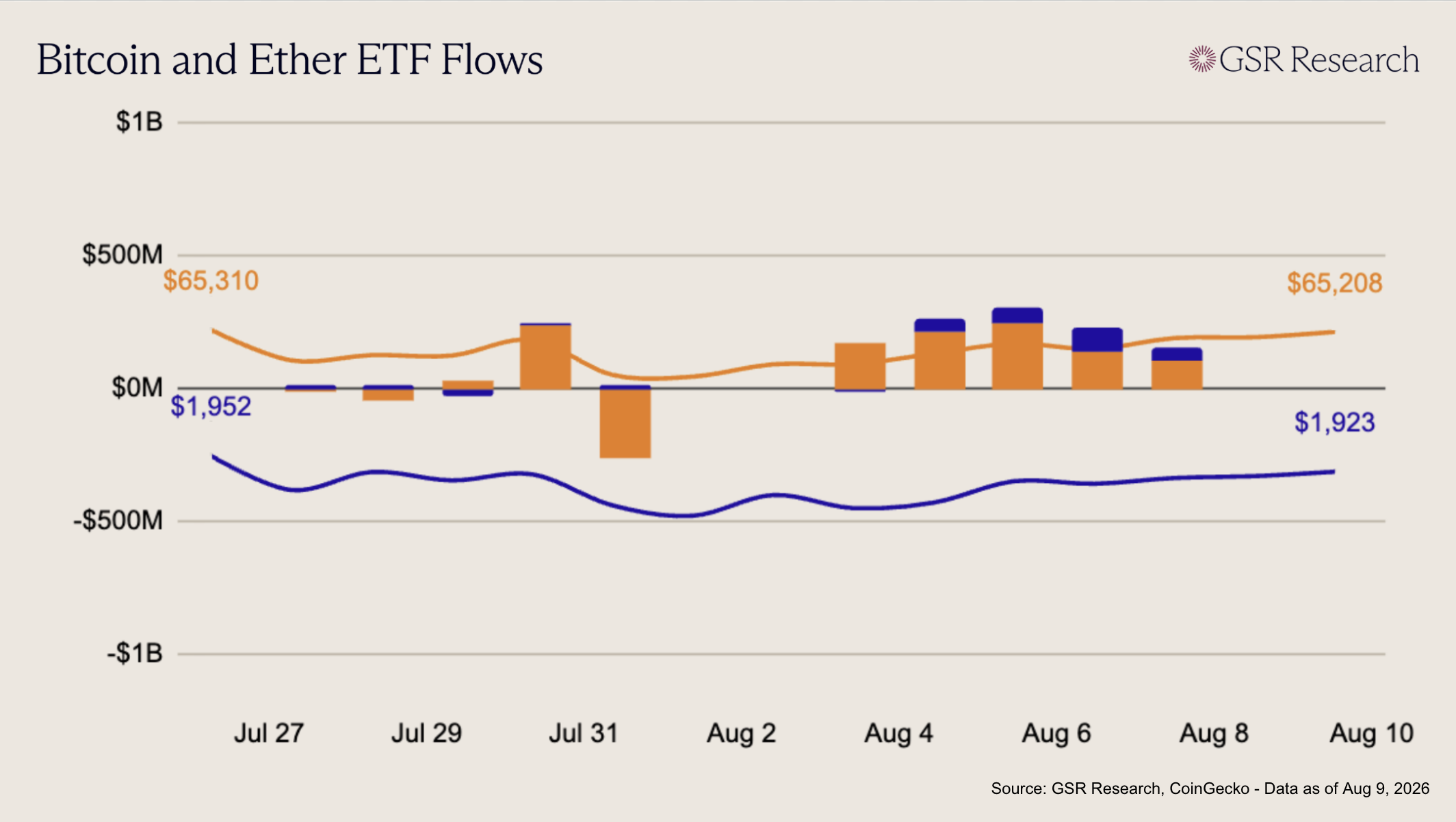
Bitcoin ETFs posted a strong five-day run of inflows this week, with +$170.1M on Aug 3, +$211.5M on Aug 4, +$244.4M on Aug 5, +$137.6M on Aug 6, and +$101.7M on Aug 7. IBIT was the main engine, contributing +$693.5M across the week, while FBTC added +$116.5M and ARKB +$50.8M. Smaller funds were mixed, with BTCO and HODL modest drags, but they were more than offset by the big three. Across the five sessions, BTC ETFs gained roughly $865.3M, showing broad-based demand and a clean extension of the July rebound.
Ether ETFs were positive too, but with a choppier path. The week opened with a small outflow on Aug 3 (-$11.9M), then turned steadily positive on Aug 4 (+$53.1M), Aug 5 (+$60.8M), Aug 6 (+$92.1M), and Aug 7 (+$49.6M). ETHA did most of the heavy lifting at +$203.0M for the week, while FETH added +$24.2M and ETHB +$12.7M. ETHE remained a small drag at -$4.7M, not enough to offset the broader bid. Across the five sessions, ETH ETFs gained roughly $243.7M, a solid print.
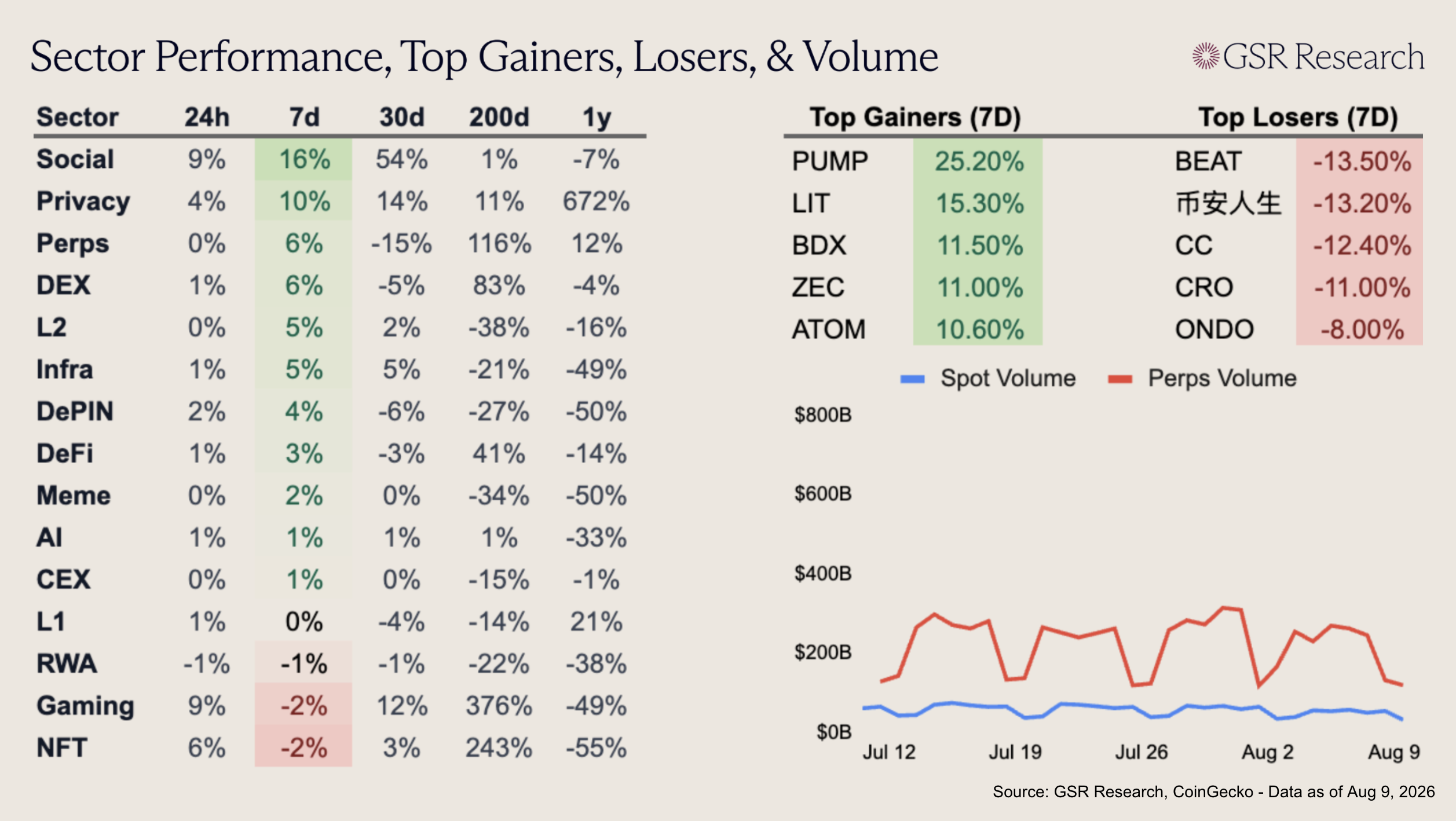
Most of the board finished green this week, led by Social (+16%) and Privacy (+10%), with Perps, DEX, L2, and Infra also up mid-single digits. PUMP (+25.20%) extended its rally for a third straight week as platform revenue climbed 30% week over week to $7.56m, topping Hyperliquid's, with the team continuing to direct half of net revenue into buybacks and burns. Privacy strength ran through ZEC (+11.00%) and the broader privacy basket, XMR included, as sentiment normalized following Zcash's Ironwood activation. LIT (+15.30%) rallied on visible whale accumulation, while BDX (+11.50%) rode the same privacy-sector bid as ZEC and XMR.
The loser board was the mirror image, with last month's momentum names giving back. BEAT (-13.50%) continued unwinding, while CC (-12.40%) fell as a chaotic week of capital reallocation around CLARITY Act disputes saw traders rotating out of laggards. CRO (-11.00%) dropped after Trump Media, Crypto.com, and Yorkville mutually terminated their $6.42b CRO treasury venture on August 7, citing market saturation, though Trump Media's existing CRO and BTC holdings remain unaffected. ONDO (-8.00%) fell amid a Delaware Chancery Court control fight.
This material is provided by GSR (the “Firm”) solely for informational purposes. It is not intended to be advice or a recommendation to buy, sell or hold any investment mentioned. Investors should form their own views in relation to any proposed investment.
It is intended only for sophisticated, institutional investors and does not constitute an offer or commitment, a solicitation of an offer or commitment, or any advice or recommendation, to enter into or conclude any transaction (whether on the terms shown or otherwise), or to provide investment services in any state or country where such an offer or solicitation or provision would be illegal. The Firm is not and does not act as an advisor or fiduciary in providing this material.
This material is not an independent research report, and has not been prepared in accordance with any legal requirements by any regulator (including the FCA, FINRA or CFTC) designed to promote the independence of investment research.
This material is not independent of the Firm’s proprietary interests, which may conflict with the interests of any counterparty of the Firm. The Firm may trade investments discussed in this material for its own account, may trade contrary to the views expressed in this material, and may have positions in other related instruments. The Firm is not subject to any prohibition on dealing ahead of the dissemination of this material.
Information contained herein is based on sources considered to be reliable, but is not guaranteed to be accurate or complete. Any opinions or estimates expressed herein reflect a judgment made by the author(s) as of the date of publication, and are subject to change without notice. The Firm does not plan to update this information.
Trading and investing in digital assets involves significant risks including price volatility and illiquidity and may not be suitable for all investors. The Firm is not liable whatsoever for any direct or consequential loss arising from the use of this material. Copyright of this material belongs to GSR. Neither this material nor any copy thereof may be taken, reproduced or redistributed, directly or indirectly, without prior written permission of GSR.
Please see here for additional Regulatory Legal Notices relevant to US, UK and Singapore.