GSR 2026 Outlook
From Speculation to Structure: Crypto's Institutional Turning Point


Crypto market structure is entering a decisive new phase. After years of speculative growth, the industry is being reshaped by regulatory guardrails, institutional participation, and the emergence of more robust exchange infrastructure that makes real-world use cases viable at scale. At GSR, we’re working to be at the center of this story by supporting our clients through updated infrastructure, ensuring crypto can function like a truly robust capital market.
2024 was defined by enforcement. With the SEC aggressively targeting token issuers, exchanges, and market makers, activity gravitated toward memecoins operating in regulatory gray zones.
The environment changed in 2025. A new U.S. administration and clearer policy direction shifted attention back to majors like BTC, ETH, and SOL, driven by institutional adoption via ETFs and digital asset treasury (DAT) companies. The passage of the GENIUS Act accelerated the proliferation of stablecoins, pushing payments use cases into focus. Liquidity providers, especially those with payments licenses and experience in remittances like ourselves at GSR, returned to provide the on/off-ramps as the addressable market expanded in a structurally compelling way.
Looking ahead in 2026, the CLARITY Act is expected to provide a holistic framework distinguishing securities from commodities, reopening the door for utility tokens and large-scale application-layer protocols. This legislation should unlock broader participation from Web2 companies and financial institutions, enabling them to tokenize existing assets, including gaming and loyalty points, cultural IP (see our section below on the recalibration of the creator economy), other RWAs, and eventually, securities and other financial instruments. Project Crypto, led by SEC Chair Paul Atkins and Commissioner Hester Peirce, will likely bring volumes back onto US onshore “superapp” trading venues such as the CME, NYSE, and Coinbase, that have all assets available under one roof, including prediction markets, which have received strategic investment from some of these TradFi market infrastructure players, and are now federally regulated by the CFTC.
GSR’s Role in a Maturing Market
Against this backdrop, 2025 was a year of focused execution for us at GSR. As crypto reached an inflection point towards real-world use cases and mass adoption, GSR concentrated on refining its platform, and strengthening its regulatory foundations, while continuing to deliver for partners across global markets.
GSR helped pioneer the formation of U.S.-listed DATs through PIPE transactions, facilitating broader access to the asset class through its dual roles as an investor and asset manager. We improved trading yields and supported sustained top-tier spot market share across major exchanges. These efforts were recognized through industry awards from partners including HashKey, Bybit, Fireblocks, and The Digital Commonwealth
Product and geographic expansion were also central themes. We launched our Systematic OTC business, offering one of the industry’s broadest fiat-to-crypto trading pair offerings coupled with the tightest spreads backed by tier 1 bank FX rates via both UI and API, with material volumes achieved since inception.

Internal Milestone Data, GSR
GSR ONE, our single-dealer platform for trade execution, analytics, and transfers, was expanded to deliver greater product breadth and transparency, while new entities established in South Korea and the UAE positioned the firm for continued growth in 2026.
Regulatory and operational strength remained a core priority. GSR further reinforced its regulatory moat through our AML registration with the FCA, the acquisition of a U.S. broker-dealer, and registration of five ETFs with the SEC.
Building Crypto’s Capital Markets Partner
As digital assets transformation continues to unfold, GSR is positioning itself as the premier capital markets partner for tokenized assets from inception to maturity, helping token issuers navigate the primary markets with our capital and connectivity, achieve organic liquidity in the secondary markets, and optimize treasury returns to achieve their long-term ambitions
Looking ahead, we remain focused on deepening our core businesses while expanding across advisory, options, DeFi, asset management, and tokenization, building toward a single objective: becoming crypto’s premier capital markets partner in a world where digital representations of a broad spectrum of underlying assets finally operate at institutional scale, to help capital formation, preservation, and transfer happen faster, cheaper, and better, for the benefit of all.
Market summary
In 2025, the cryptocurrency market transitioned from a period of speculative hype to one of structural maturity, characterized by recurring waves of volatility and rapid shifts in liquidity. While a robust mid-year rally signaled growing institutional confidence, the market faced a rigorous test in the final quarter as macro conditions tightened and risk appetite cooled.This year was defined less by a speculative ‘melt-up’ and more by systemic adoption, with deeper institutional participation and improved infrastructure providing a stabilizing foundation even when price action appeared obscured by headline-driven volatility.

Crypto Market Capitalization Data, GSR Research and Coingecko
Stablecoin flows and market plumbing
One of the clearest signals of underlying health was the continued growth in stablecoin usage and flows. Stablecoins increasingly functioned as core financial infrastructure rather than purely crypto-native instruments, facilitating payments, settlement, and cross-border transfers even during periods of broader market stress. Notably, this growth persisted through the Q4 drawdown, underscoring that stablecoin demand is increasingly tied to real-world utility and treasury management and not just to trading activity. The expansion of stablecoin issuance and experimentation by large fintech and financial institutions reinforced the view that stablecoins are becoming a foundational layer of digital finance.
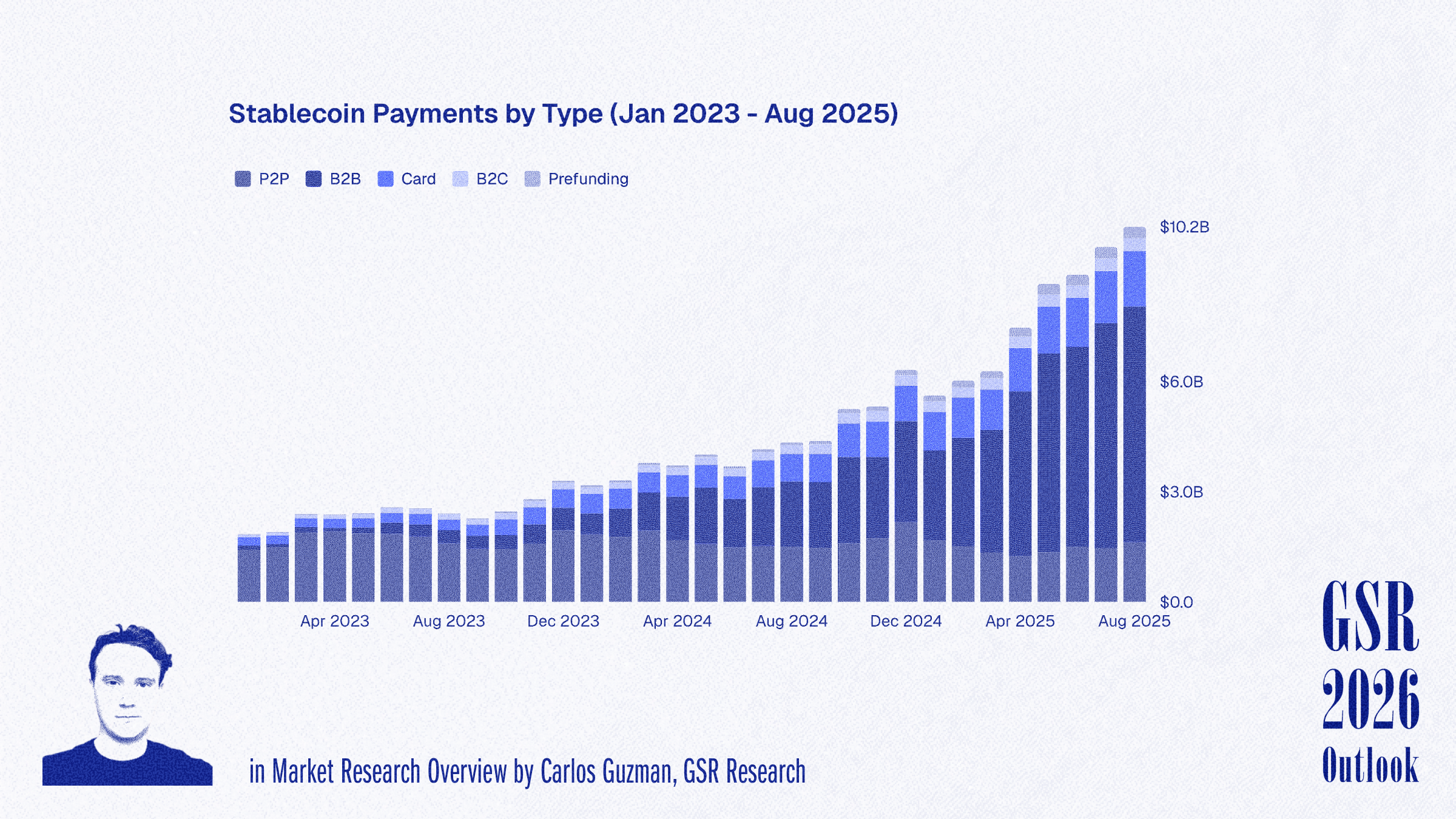
Stablecoin Payments from the Ground Up, Artemis
IPOs and what went well
Despite a tougher end to the year, 2025 marked a meaningful reopening of the crypto IPO window. High-profile listings from companies like Circle, Bullish, Figure, and Gemini signaled renewed public-market appetite for scaled, revenue-generating crypto businesses, with Bullish and Circle alone raising more than $2 billion combined. Outside of public markets, several categories exceeded expectations. Prediction markets emerged as one of the standout sectors, reaching multi-billion-dollar valuations and demonstrating real user engagement. Payments-focused companies and infrastructure providers also performed well, benefiting from stablecoin adoption and clearer regulatory pathways. Fundraising was strongest for later-stage projects with real distribution, revenue, and institutional traction, particularly in payments, market infrastructure, and RWAs.

2025 IPO Data, GSR Research
What went poorly and lessons learned
Not everything played out as anticipated. Launch models and valuation expectations often proved misaligned with actual market demand, particularly for earlier-stage or highly narrative-driven projects. In several cases, teams and investors overestimated the speed at which liquidity, users, or revenue would materialize post-launch. Looking back, this was a humbling period that reinforced the limits of forecasting in a rapidly evolving market. Some of the optimism expressed in prior outlooks around broad-based retail re-engagement and rapid adoption of new token models proved premature, especially as macro conditions tightened into Q4.
Outlook and where crypto investing is going
Looking ahead, we expect continued convergence between fintech and crypto investors, with capital increasingly flowing to companies that blend regulatory credibility, strong distribution, and crypto-native innovation. In this balance, incumbents with existing user bases, brand trust, and compliance infrastructure are well-positioned, particularly when paired with crypto-first technology and talent. We believe the next phase of value creation will skew toward later-stage deployment rather than pure experimentation. While 2025 was uneven, it also made clear that crypto’s center of gravity is shifting toward institutional adoption, real-world use cases, and integration with the traditional financial system. That structural trend, more than short-term price action, continues to guide our long-term outlook.
Heading into 2026, the U.S. regulatory outlook for digital assets is more constructive than it has been in years. The challenge is no longer whether policymakers want to act, but whether they can execute. Engagement with Congress and the Executive Branch in late 2025 suggests the core elements of crypto market structure legislation are largely agreed upon on a bipartisan basis. What remains are political bottlenecks and unresolved edge issues: headline risk from Trump‑adjacent crypto ventures, delayed agency leadership confirmations, and lingering disagreements around stablecoin rewards. These factors have slowed the translation of consensus into law, even as the direction of travel has become clearer.
At a high level, U.S. crypto regulation in 2026 should be judged against two straightforward objectives. First, creating safe, clearly defined lanes for crypto entrepreneurs to build in the United States without living under constant threat of retroactive enforcement. Second, bringing global trading activity back onshore and reversing the unusual reality that the majority of a major financial market operates outside U.S. borders.
Most policy debates that matter in 2026: market structure, token classification, and liquidity provision, ultimately map back to these two goals.
Market Structure and Ancillary Assets
One of the most encouraging developments is growing alignment around a more functional approach to crypto market structure. Under this view, assets that are not securities in the traditional sense should be treated as commodities once they are trading in secondary markets, even if capital formation and fundraising appropriately remain within the SEC’s remit.
This reflects how markets actually function. The SEC has long overseen disclosures and conduct, while commodities regulators focus on trading, market integrity, and derivatives. Applying that same logic to digital assets provides a clearer and more intuitive framework than attempting to stretch securities law concepts to cover the full lifecycle of a token.
Importantly, this approach does not imply deregulation. Where projects retain meaningful centralized control or continue to play an active managerial role, it makes sense to require tailored disclosures that allow market participants to understand risks, incentives, and governance. The challenge is ensuring that these disclosure regimes are scaled appropriately and do not impose IPO‑style compliance burdens on early‑stage startups that lack the capital or organizational maturity to support them.
Done correctly, this model would provide issuers with clearer expectations at the point of fundraising, while allowing non‑security tokens to trade in well‑regulated commodity markets with rules designed for liquidity, price discovery, and surveillance. That clarity is essential for building compliant onshore venues and attracting institutional participation, rather than leaving markets stuck in regulatory limbo.
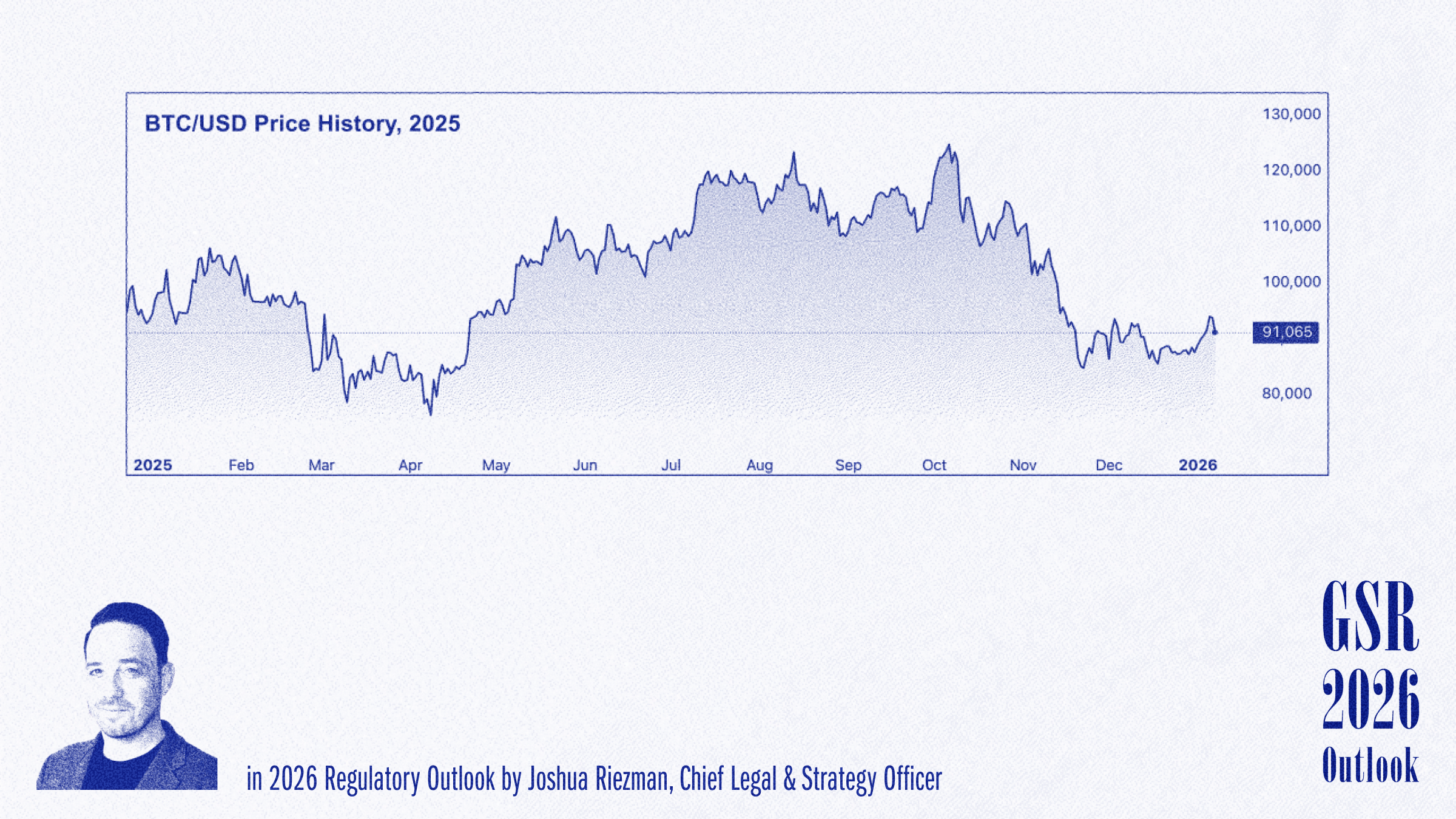
BTC/USD 2025 Data, Tradingview
Competitiveness, Not Just Compliance
A second and increasingly important shift is the reframing of crypto regulation around U.S. competitiveness. Today, more than 80% of global crypto trading volume still occurs offshore, a dynamic that is almost unheard of in other major financial markets. Policymakers are beginning to recognize that overly complex, prescriptive, or ambiguous rules do not eliminate risk; they simply export activity, liquidity, and talent.
In 2026, this competitiveness framing is likely to move to the center of the conversation. Effective regulation will need to protect customers and make the U.S. an attractive venue for capital formation and trading else increase the risk of creating a beautiful walled garden that does not achieve the two main objectives described above. That implies a greater emphasis on technology‑neutral rules that regulate outcomes, fair markets, disclosure, integrity rather than dictating specific technical architectures or development paths.
If the goal is to attract offshore volume back onshore, clarity and workability matter more than theoretical purity.
Two Important Issues: Token Classification and Liquidity
1. Token Classification That Works in Practice
If Congress and regulators move toward a functional “network token” or non‑security token framework, it must be grounded in objective, observable criteria tied to how a token actually functions and accrues value. A regime that looks only to historical issuance mechanics, while ignoring present‑day design, use, and decentralization, risks recreating the same enforcement‑driven uncertainty that has plagued the market for the last several years.
For token classification to be credible, market participants need to be able to assess a token from the outside based on its architecture, governance, economic rights, and real‑world use without needing privileged insight into legacy fundraising narratives. That clarity is essential not just for issuers, but for investors, trading venues, and advisors allocating capital in 2026.
2. Making Room for Liquidity Providers
The second issue is the treatment of liquidity provision and market making. It is worth acknowledging up front that this is an area where firms like GSR have a direct commercial interest. That said, the policy case stands on its own. Deep, resilient markets do not exist without professional liquidity providers willing to quote both sides, hold inventory, and absorb volatility.
Explicit exemptions or safe harbors for bona fide market-making activity, would materially improve market quality. These are not special carve‑outs so much as recognition of how modern electronic markets function across asset classes.
Absent this clarity, liquidity providers remain exposed to legal risk that discourages onshore participation, leading to thinner books, wider spreads, and greater volatility. From a market structure perspective, that outcome is self‑defeating. If the U.S. wants robust, institutional‑grade crypto markets, it must affirmatively allow liquidity providers to do what they do best.
Looking Ahead
2026 is shaping up to be a transition year for U.S. crypto regulation. The next phase is unlikely to produce sweeping new visions; instead, it will focus on operationalizing ideas that are already broadly agreed upon. Progress may be uneven, but even partial advances on market structure, token classification, and liquidity treatment would represent meaningful steps forward.
For market participants, the signal is clear. The U.S. is moving slowly but decisively toward a crypto market that is regulated, competitive, and institutionally accessible. The remaining question is how quickly policymakers can turn intent into implementation.
2025 marked a highly active yet increasingly selective year for GSR in venture investing. Crypto venture capital deployment proved resilient, with total funding reaching $18.9 billion in 2025, up 22% year-over-year, marking the strongest annual total since 2022. However, this growth masked a meaningful structural shift beneath the surface. While dollars deployed increased, the number of venture deals declined sharply, signaling a market that is maturing and consolidating rather than broadly expanding.
According to The Block, traditional crypto venture deal count fell ~60% year-over-year, driving average transaction sizes significantly higher—from approximately $4.7 million in 2024 to $16 million in 2025—as capital concentrated in fewer, larger raises led by established teams and later-stage companies. Within this environment, GSR remained active across a broad set of venture categories, with particular emphasis on DeFi, infrastructure, and core financial services that underpin scalable onchain adoption. As investors increasingly prioritized regulatory clarity, durable revenue models, and operational maturity over speculative early-stage experimentation, GSR found opportunities where long-term fundamentals aligned with the evolving market—resulting in a diversified, conviction-driven venture portfolio reflective of the industry’s future.

GSR 2025 Venture Investment Breakdown
Crypto venture capital in 2025 reflected a market becoming more disciplined. While overall funding remained resilient, capital allocation shifted meaningfully toward fewer, larger investments backed by stronger fundamentals.
Early in the year, token-focused funding was softer than expected. As the year progressed, later-stage, equity-style rounds came to dominate activity. This transition shows a broader change in investor priorities, with the market moving away from speculative token exposure toward businesses demonstrating traction and revenue.
Fewer Deals, Higher Conviction
A defining feature of 2025 was the decline in deal count alongside rising average check sizes. Rather than signaling reduced appetite, this reflected a higher bar for deployment. Investors focused on growth metrics, unit economics, and credible paths to profitability, concentrating capital where outcomes appeared predictable.
The presence of multiple viable exit paths throughout the year further reinforced this behavior. In an uncertain environment, investors favored clarity and execution over optionality, leading to more concentrated portfolios.
Early-Stage Capital Returns—Selectively
Looking ahead to 2026, early-stage activity is expected to rebound under stricter conditions. Capital remains available, though founders face higher expectations around traction and execution. Narrative-driven investing has given way to more rigorous evaluation, even as the industry generates new ideas and opportunities.
Where Capital Is Flowing
Real-world asset tokenization remains a priority, particularly infrastructure supporting liquidity and trading. Stablecoin and payments infrastructure, institutional-grade trading and risk tooling, and crypto-native financial products addressing real operational needs continue to attract interest. Meanwhile, funding for blockchain infrastructure is becoming more selective. Incremental approaches face a higher hurdle, with clear value creation now essential.
A More Measured Phase of Growth
Beyond venture rounds, 2025 marked the early stages of broader consolidation. M&A activity picked up as companies sought scale, capabilities, and long-term positioning, while public market access improved for businesses with sufficient size and maturity. Overall, 2025 reflected an industry entering a more measured phase of growth defined by focus, execution, and durability.
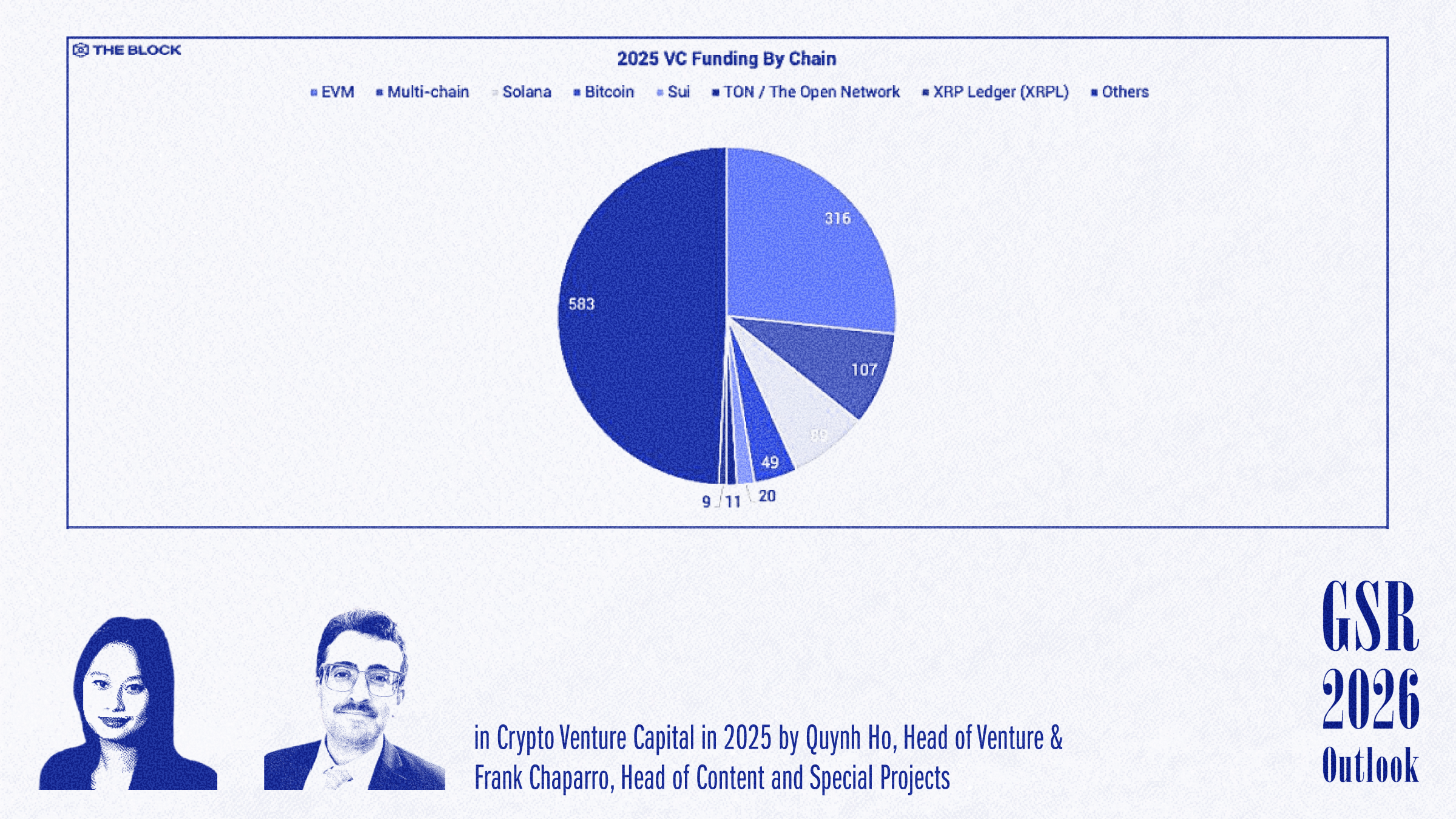
VC and DAT Funding Data, The Block Data Dashboard
Exit liquidity has always mattered. But today, it matters more than ever. We often talk about exit liquidity as an abstract endpoint – an IPO, an acquisition, a token listing. In practice, it is the lifeblood of investment returns. Without credible liquidity, capital stagnates, risk appetite contracts, and innovation slows. What’s changing now is not just that liquidity is returning to crypto, but that the mechanisms for achieving it are becoming broader, more institutional, and more grounded in fundamentals.
Over the past few years, liquidity in crypto was largely driven by token unlocks and venture secondaries. These tools kept capital moving during a difficult market cycle, but they were often narrow, volatile, and heavily sentiment-driven. Today, we are seeing a reopening of multiple exit pathways — including public listings, M&A, and selective token issuance — supported by improved regulatory clarity and renewed investor confidence. Public markets are a clear signal of this shift. Globally, IPO activity has recovered meaningfully, with more than 170 listings raising over $30 billion year-to-date. Within digital assets, several companies have completed or progressed toward public listings in 2025, collectively raising over $5 billion. A growing pipeline of exchanges, asset managers, custodians, and infrastructure providers is preparing for the public markets over the next 24 months.
At the same time, new forms of public crypto exposure are emerging. Publicly traded “digital asset treasury” companies — firms that hold crypto on their balance sheets — now collectively hold a meaningful share of Bitcoin, Ethereum, Solana, Avalanche, XRP, etc in circulation. These vehicles have raised more than $15 billion in 2025 alone, reflecting increasing institutional comfort with crypto exposure in familiar corporate structures.
What distinguishes this cycle from 2021 is discipline. Public investors are underwriting revenue durability, governance, regulatory posture, and capital efficiency, rather than growth narratives alone. Private valuations are adjusting to reflect this reality, reducing the risk of liquidity events that fail to translate into real distributions. As exit markets reopen, the industry is also grappling with how value accrues across equity and tokens. Several leading companies illustrate different approaches.
Ripple combines a payments-focused operating business with XRP, a globally traded token that underpins parts of its network. Coinbase, as a public company, is valued on its trading, custody, and financial services revenues, while its Layer 2 network, BASE, strengthens its ecosystem and long-term strategic positioning. Consensys and MetaMask generate equity value through software and tooling, alongside the Linea token, which captures value at the network layer.
In each case, markets are learning to distinguish between corporate cash flows and network-driven value, and to price them with increasing sophistication. There is no single correct structure — but clarity on incentives and value accrual is becoming essential. In each case, markets are learning to distinguish between corporate cash flows and network-driven value, and to price them with increasing sophistication.
M&A activity further reinforces this maturation. Public and well-capitalized crypto companies are increasingly using their balance sheets to acquire capabilities, consolidate market share, and deepen regulatory or distribution advantages. At the same time, traditional financial institutions and fintechs are making strategic entries into crypto, accelerating convergence between the two worlds.
For investors, the focus remains on distributions to paid-in capital. The most resilient portfolios are those built around exit optionality rather than exit certainty — ensuring that if one path closes, others remain viable. Secondary markets, tokenized shares, and interim liquidity solutions may complement traditional exits, but durable outcomes will continue to depend on business quality and market readiness.
Ultimately, exit liquidity is not just about getting out. It’s about who comes in next. As crypto continues to integrate with global capital markets, the winners of the next cycle will be those who design businesses — and capital structures — that can attract long-term capital while preserving flexibility across multiple exit paths.
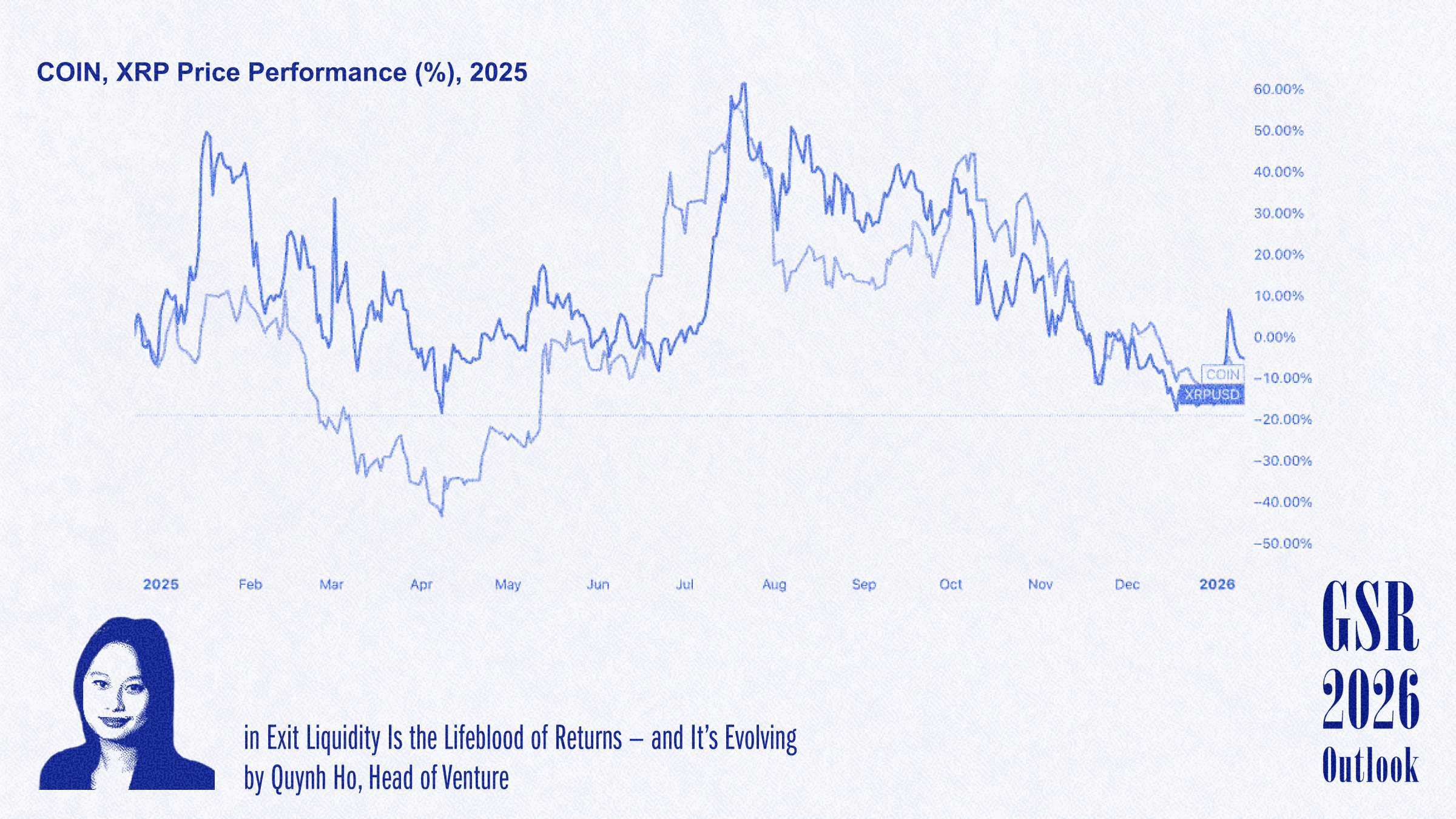
COIN, XRP 2025 Price % Data, TradingView
Stablecoins are the next monetary cold war
A quiet cold war is emerging around stablecoins between nation-states. At the surface, stablecoins look like a narrow crypto primitive: digital tokens pegged to fiat currencies used for trading and payments. In reality, they are becoming global monetary infrastructure. Wherever stablecoins are adopted, the underlying currency inherits reach, liquidity, and influence. This is why stablecoins are no longer just a crypto product — they are a geopolitical one.
Today, the vast majority of stablecoins are dollar-denominated. USDC, USDT, and their variants function as programmable eurodollars, circulating freely across borders, often in places where access to U.S. banking is limited or unreliable. In emerging markets, stablecoins increasingly serve as savings vehicles, payment rails, and settlement layers. Every transaction strengthens the USD’s network effects without requiring U.S. banks, SWIFT, or direct state coordination.
This creates a strategic asymmetry. The United States benefits from dollar stablecoins extending monetary dominance into the digital, while retaining leverage through reserve custody, regulation, and compliance. Tether already sits as the 17th largest holder of US Treasury bills, composed of capital from foreign users. Other nations see the risk clearly: if USD-backed stablecoins become the default internet money, their local monetary sovereignty erodes. Capital controls weaken. Domestic payment systems lose relevance. Policy tools become less effective.
Every other nation is competing with USD to embed themselves in the lives of their own people and globally. In that sense, stablecoins are not just the future of money, they are the next battlefield for global power. Expect nations to launch CDBCs and work with stablecoin issuers to unveil local stablecoins.
ICOs make a comeback
Airdrops are effectively dead. Prolonged VC lockups create persistent overhang, making it difficult for liquid funds and retail participants to engage as long-term holders. At the same time, projects often TGE during the most capital-intensive phase of a startup’s lifecycle, often forcing teams to sell tokens OTC or into the open market simply to fund operations. ICOs reintroduce a cleaner alternative. They allow for early price discovery and enable retail and liquid funds to align meaningfully in a protocol’s upside and downside without the structural issues inherent in airdrops and lockups.
Just as importantly, an ICO can establish a psychological “soft floor” for a token’s price at launch — a dynamic not unlike late-stage private rounds that occur shortly before an IPO in traditional markets. Platforms like Echo, Sonar, CoinList, Legion, and others are already exhibiting early but meaningful product-market fit – helping companies raise capital from the most fervent user base.
Taste & empathy: a competitive advantage
AI has made creation cheap and ubiquitous, resulting in a degradation of content and products. But when supply explodes and functionality becomes increasingly commoditized, taste emerges as one of the primary differentiators in products. This presents an enormous opportunity. People with exceptional taste and empathy are experiencing a rapid development in the ability to commercialize their judgment.
Financial products, in particular, remain one of the best areas for crypto to build taste-driven disruption. Over the past two decades, category-defining fintech companies have won by pairing better UI/UX with existing financial infrastructure — abstracting complexity into simple, intuitive experiences.
Robinhood made trading accessible through zero-fee execution and fractional shares; Stripe unified payments behind elegant APIs; Plaid unlocked bank connectivity; Shopify simplified e-commerce operations. Blockchain rails have the potential to rebuild many of these systems from the ground up — making them more efficient, programmable, and globally native.
Elon Musk, Taylor Swift, Mr Beast, Cristiano Ronaldo, and Kylie Jenner have a combined reach approaching three billion people. We have never seen this level of distribution concentrated in individuals outside of presidents, prophets, or gods. A combination of generative AI and emotional bandwidth collapse is now prompting people to reassess what actually matters. The creator economy is entering the early stages of a shift toward a relationship economy. The growing understanding that we can have, and will have, infinite content moves the centre of gravity away from sheer scale and toward the places where connection, continuity, and emotional investment truly live. Platforms will begin prioritising features that preserve a sense of shared history, capturing who shows up, who contributes, and who grows alongside you.
This pushes the quality of engagement to the forefront instead of churn of new posts. People are overwhelmed by information and want stronger, more meaningful connections within hyper-personalised environments, still maintaining the freedom to explore outside their bubbles, but filtering out unnecessary noise. Prediction markets have already shown the power of attaching value to opinion. The idea of putting money behind a belief creates a public signal of conviction, reputation, and measurable outcomes. Web3 extends this logic to relationships through portable identity, persistent contribution, and ownership of the micro-actions people already express every day. Emotional participation is not new. Users already tip streamers, buy digital cosmetics, and pay for status with no expectation of direct value return. What changes now is the ability to own these signals, carry them across platforms, and build an identity that compounds over time.
As this deeper relationship layer becomes visible, creators understand that their real moat is familiarity and trust rather than output volume. People enjoy backing others early, feeling part of a progressive journey, yet there has been little focus on reflecting the depth or history of that support. Relationship-native monetisation will begin to surface inside mainstream platforms, but will not look like subscriptions, rather high-trust micro-affiliations where supporters gain recognition and creators gain income from the depth of their connections. Think Spotify Wrapped, but more than just posting how much you like Olivia Dean. The experience feels less like paying for content and more like joining a shared narrative.
Marketing spend will adjust its priorities toward the touch points that deliver genuine conversion rather than simple impressions. The strongest products will shift from optimising for attention to optimising for affection. Creators will gain independence as audiences move from being owned by platforms to becoming peer-to-peer relationships.
In 2025, we launched The Crypto Tape to host honest, unscripted conversations at the intersection of finance and digital assets—focusing as much on the frictions and failures of market structure as on its promise. For this report, we revisited several past guests to understand how they’re thinking about 2026.
Across market structure, infrastructure, policy, and custody, a clear throughline emerged: crypto is moving from speculation toward durable financial plumbing. Guests expect institutional participation to deepen through tokenization, derivatives, and stablecoins; adoption to become increasingly “invisible” as blockchain infrastructure fades into the background; and consolidation to reward fundamentals over froth. At the same time, unresolved challenges—from tax policy and regulatory execution to latency, custody UX, and inheritance—remain critical battlegrounds that will shape whether this next phase of growth is sustainable.
Domingo argues that 2026 will mark crypto’s transition from speculative narratives to durable financial infrastructure. Regulatory clarity and institutional adoption will favor native tokenization over synthetic exposure, reshaping how real-world assets integrate with DeFi.
Upcoming regulatory developments and the growing presence of tokenized traditional assets will ultimately strengthen crypto market structure. These changes push crypto markets closer to traditional finance — but on more efficient rails. That shift may disappoint speculators chasing constant 10x opportunities, replacing them with a slower, fundamentals-driven evolution.
One of the most misunderstood opportunities today is the difference between native tokenization and derivatives or price trackers. Owning an asset outright — without added counterparty risk — is fundamentally different from holding synthetic exposure. While native tokenization requires issuer participation and regulatory alignment, it represents a much larger and more durable opportunity.
By 2026, truly compliant DeFi integrations for lending and trading tokenized real-world assets will accelerate. Over time, these assets may become the dominant collateral and settlement layer within DeFi.
Demirors sees 2026 as the beginning of crypto’s top-down phase, where its primitives are embedded directly into existing markets. DeFi expands beyond crypto-native use cases, while the industry consolidates around fewer, more durable blockchains.
The past decade of crypto was defined by bottom-up innovation — new capital markets, new financial contracts, and new mechanisms for capital formation outside traditional systems. The next decade will be about embedding those primitives into real businesses and markets, enabling any asset to trade, clear, margin, and settle on crypto rails.
DeFi is entering a new narrative arc, moving beyond purely endogenous markets into infrastructure finance, undercollateralized lending, and the industrial economy — including data centers, manufacturing, and energy. This convergence represents one of the largest adoption opportunities for crypto.
At the same time, the industry is heading toward consolidation. Fragmented liquidity, convoluted governance, and weak token economics are becoming harder to sustain. Institutions have arrived — not by crypto conforming to traditional finance, but by global markets increasingly behaving like crypto.
McCordic expects institutional adoption to accelerate faster than expected in 2026, driven by stablecoins, onchain settlement, and performance-critical financial infrastructure — much of it abstracted away from end-users.
2026 will be a year of acceleration and consolidation. Institutional adoption is starting and will snowball faster than most people realize. Stablecoins are moving from crypto-native tools into everyday payment and B2B settlement systems, while onchain settlement begins to compete directly with legacy networks.
High-frequency financial infrastructure requires predictable execution across multiple asset classes. Institutions need to manage positions in real time, but they also require decentralization — centralized sequencers are not acceptable points of trust. Performance alone won’t be enough.
Much of this adoption will be invisible. Blockchain technology will increasingly sit beneath applications, services, and payment flows, abstracted away so end-users may not even realize crypto infrastructure is being used at all.
Warner argues that crypto has hit the limits of protocol-level optimization. In 2026, performance, decentralization, and fairness will depend on network infrastructure — not just block times or throughput.
In 2025, infrastructure progress focused on faster block times and better execution engines. But many of the real limits aren’t coming from consensus — they’re coming from the underlying network. Crypto markets are more time-sensitive and institutional, yet still rely on a best-effort public internet.
Scaling is often framed as a throughput problem, but higher TPS doesn’t matter if data propagation is inconsistent or unpredictable. Likewise, decentralization doesn’t live solely at the protocol layer if traffic still flows through the same network chokepoints.
The opportunity lies in shared, composable performance infrastructure. Making low-latency networking a common resource changes what’s possible to build onchain — not just how fast blockchains run.
Perkins thinks 2026 is less about chains flipping each other and more about institutions steadily displacing retail as the marginal price-setter. The path in won’t be spot speculation—it’ll be regulated derivatives, basis trading, and a market that increasingly rewards fundamentals over froth.
We’re entering a phase he calls the “Great Flippening”—not Ethereum flipping Bitcoin, but institutions slowly and steadily displacing retail’s “hot ball of money.” Regulatory normalization and a pro-crypto posture in Washington changed the calculus. For institutions, there’s now risk in not having a crypto strategy.
To win in this market, you have to understand how institutions will enter and use crypto infrastructure. Fundamentals take the wheel. As a frontier risk asset, the volatility of many crypto assets—especially alts—remains unpalatable. The return of derivatives and regulated onshore futures enables basis trading, and that becomes a natural institutional entry point.
The result is bifurcation: tokens with regulated futures markets attract institutional participation; tokens without them remain more retail-driven. While liquidations and leverage cycles will keep coming and going, the institutional march forward is slower—and more durable.
Bron’s core claim is blunt: self-custody won’t scale until wallets become secure by default—and that means moving beyond seed phrases toward biometric signing, plus building “bank-app-level” bundled services (borrowing, payments, protection) inside self-custody. He also flags inheritance as the sleeper issue for 2026.
In short: the death of the seed phrase and the birth of biometric signing. Banking apps—especially neo-banks—have done a real job integrating people’s financial lives: tap-to-pay, simple transfers, card controls, and usability that most people don’t hate. But they still lack true security. It’s still far too easy to be robbed, socially engineered, or drained—financial lives can be hijacked faster than most people want to admit. People assume they’re safe because it hasn’t happened to them—when in reality, it just hasn’t happened to them yet.
Bron’s Wallet is built to counter those persistent threats, and he expects wallets to start absorbing more services the way banking apps did—becoming a one-stop shop for digital asset necessities like borrowing. Functions that used to live on centralized exchanges will migrate into secure self-custody.
Beyond that, he expects big 2026 wallet themes to cluster around privacy and encryption, interoperability (cross-chain swaps), and digital inheritance. Estate planning hasn’t modernized in centuries, and most legal systems aren’t prepared for self-custody, keys, and DeFi positions. With a massive generational wealth transfer approaching, if wallets don’t handle inheritance cleanly, users are effectively gambling with their families’ financial well-being.
Park argues that 2026 will reward conviction over passive exposure. As geopolitics, executive power, and national security priorities increasingly shape markets, alpha will come from attention and positioning rather than broad beta. Regulatory shifts and derivatives innovation quietly lay the groundwork for the next phase of institutional participation.
2026 will be the year of the ideological investor, where conviction and attention dominate alpha generation. Geopolitical goals tied to national security agendas—often enforced through executive decree—will continue to move markets as the Washington Consensus fades. At the same time, structured flows from agentic investing will treat “AI inclusion” as the new index inclusion.
The SEC’s posture toward innovation remains underrated. Significant reforms could expand access to innovative financial products, particularly in prediction markets and Regulation CF opportunities across private markets.
Another underappreciated development from 2025 is the increase in open interest limits for Bitcoin ETF options. That shift has meaningful implications for structured product issuance, unlocking a powerful wealth management distribution channel for income-based products.
Looking ahead, the next wave of institutional interest is likely to come from RIA-driven model portfolio flows, alongside growing corporate adoption of Bitcoin on technology company balance sheets.
After years of regulatory fragmentation, 2025 reset U.S. crypto policy. With legislation passed and leadership in place, 2026 shifts from groundwork to execution. Agencies are aligning, rules are being written, and regulatory certainty is finally coming into view—though tax policy remains a major, underappreciated hurdle to adoption.
2025 was about laying the foundation: passing the GENIUS Act, advancing market structure legislation, and confirming new leadership at the SEC and CFTC. With that work done, 2026 is about execution. The SEC and CFTC are entering a historic period of coordination, Treasury is implementing the GENIUS Act’s stablecoin framework, and the Senate continues to move market structure legislation forward. This marks a decisive break from the fragmented, enforcement-first approach of prior years.
One of the most overlooked barriers remains tax policy. Today, using stablecoins for everyday payments creates taxable events for both the asset and the gas fees, forcing users to track cost basis on even tiny transactions. That system doesn’t scale and actively discourages real-world blockchain uSe, while staking rules further complicate participation.
The biggest downstream impact from 2025 was the broader policy reset itself—moving the U.S. from regulation by enforcement toward global leadership. That shift, combined with the SEC’s openness to onchain capital markets and tokenized securities, creates a real opportunity for policymakers and the industry to collaborate on building internet-native financial markets.
Leshner draws a sharp distinction between surface-level tokenization and true market transformation. In 2026, he expects attention to shift away from proxy assets and wrapper tokens toward the less visible—but far more consequential—infrastructure required to bring real securities fully onchain.
Overrated: Third-party stock wrapper tokens. They’re stepping stones, not long-term solutions. Adding intermediaries misses the point—progress comes from removing layers and building a more efficient path between the asset and the investor.
Underrated: Direct issuance infrastructure. Transfer agents, tokenized corporate actions, and real-time settlement rails may be boring, but they’re what actually allow companies to issue securities onchain. The back-end matters more than the front-end.
This material is provided by GSR (the “Firm”) solely for informational purposes. It is not intended to be advice or a recommendation to buy, sell or hold any investment mentioned. Investors should form their own views in relation to any proposed investment. It is intended only for sophisticated, institutional investors and does not constitute an offer or commitment, a solicitation of an offer or commitment, or any advice or recommendation, to enter into or conclude any transaction (whether on the terms shown or otherwise), or to provide investment services in any state or country where such an offer or solicitation or provision would be illegal. The Firm is not and does not act as an advisor or fiduciary in providing this material. This material is not an independent research report, and has not been prepared in accordance with any legal requirements by any regulator (including the FCA, FINRA or CFTC) designed to promote the independence of investment research. This material is not independent of the Firm’s proprietary interests, which may conflict with the interests of any counterparty of the Firm. The Firm may trade investments discussed in this material for its own account, may trade contrary to the views expressed in this material, and may have positions in other related instruments. The Firm is not subject to any prohibition on dealing ahead of the dissemination of this material. Information contained herein is based on sources considered to be reliable, but is not guaranteed to be accurate or complete. Any opinions or estimates expressed herein reflect a judgment made by the author(s) as of the date of publication, and are subject to change without notice. The Firm does not plan to update this information. Trading and investing in digital assets involves significant risks, including price volatility and illiquidity and may not be suitable for all investors. The Firm is not liable whatsoever for any direct or consequential loss arising from the use of this material. Copyright of this material belongs to GSR. Neither this material nor any copy thereof may be taken, reproduced or redistributed, directly or indirectly, without prior written permission of GSR. Please see here for additional Regulatory Legal Notices relevant to US, UK and Singapore.