GSR Weekly Update - March 16th, 2026
BTC: $71,464 (+6.3%) | ETH: $2,094 (+7.7%) | BTC Dom: 56.9% | Global Cap: $2.51T


On March 9th, Kraken announced a partnership with NASDAQ to develop the Equities Transformation Gateway, a framework that will enable tokenized equities to move between regulated capital markets and public blockchains. Scheduled for launch in H1 2027, the Gateway will integrate Kraken's xStocks platform, which was acquired from Backed Finance in December 2025, directly into NASDAQ's equity token infrastructure. The partnership redefines the landscape for stock tokens as it directly addresses the central tension that has defined tokenized equity markets to date: the tradeoff between DeFi composability and legitimate equity ownership.
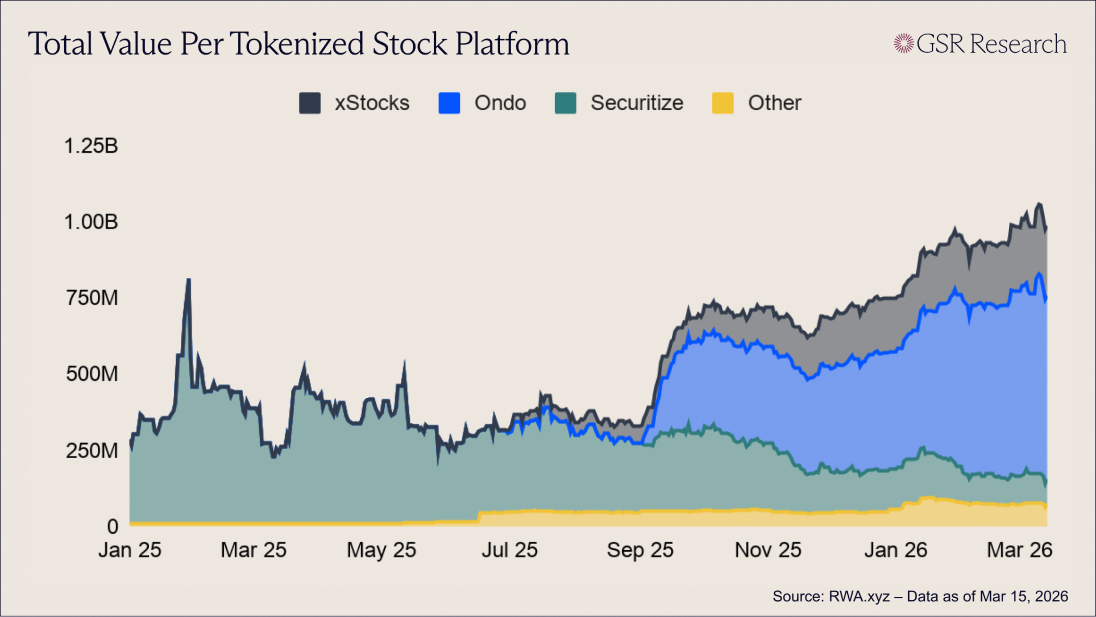
Solutions for tokenizing stocks onchain have historically split into two camps. Custodial platforms like xStocks and Ondo Finance purchase shares on the open market, house them in special purpose vehicles (SPVs), and issue tokenized wrappers onchain. Conversely, digital transfer agents like Securitize work directly with public companies to issue shares natively onchain as the legally recognized security itself. Each approach carries clear advantages and significant drawbacks, and neither has managed to deliver on the full promise of tokenized equities.
Custodial platforms like Ondo and xStocks have dominated adoption metrics since their inception in mid-to-late 2025. By simply purchasing any publicly listed stock and minting a wrapper, xStocks was able to tokenize 200 companies within days of its July 2025 launch. Additionally, since those tokens remain standard ERC-20 and SPL tokens, they have spread rapidly through DeFi as collateral, liquidity, and trading instruments. But this speed required structural concessions. Because custodial tokens are debt instruments representing an interest in an SPV, not actual equity, holders lack voting rights and face counterparty risk. Most importantly, even though token transfers happen instantly onchain, the underlying shares remain subject to traditional T+1 settlement, meaning custodial platforms fail to deliver the core financial upgrade that tokenization promises: the elimination of clearinghouse margin requirements that currently lock up billions in idle capital.
Digital transfer agents mitigate the structural risks inherent in custodial models. Their tokens represent direct ownership in the underlying security, enabling true T+0 settlement and full shareholder rights. However, like custodial platforms, digital transfer agents come with their own set of drawbacks. Launching a single equity onchain requires extensive regulatory and financial due diligence. Additionally, because the tokenized equity is the legally recognized share itself, digital transfer agents have had to concede almost all functionality. This means restricting trading to whitelisted wallets, zero composability within DeFi, and ultimately an overall experience that is functionally indistinguishable from a traditional brokerage.
The NASDAQ partnership positions xStocks as the platform that will finally bridge this divide. Under the Equities Transformation Gateway, xStocks tokens will evolve from synthetic interests in SPVs to direct ownership of the underlying security, with the blockchain record integrated into the company's official share registry. Onchain transfers will constitute actual share transfers with T+0 settlement, while the platform aims to retain its existing DeFi composability and rapid deployment capabilities.
However, the partnership comes with significant tradeoffs for current users. Kraken will be required to KYC all users interacting with stocks bridged through the Gateway, and DeFi activity involving those tokens will be restricted to whitelisted addresses, likely through permissioned pools in protocols like Aave and Uniswap. NASDAQ will also need to approve each company individually before it passes through the Gateway, slowing the pace of tokenizations. The legacy, permissionless xStocks product will continue to operate in the interim, though it will remain a legally-ambiguous debt instrument that is likely to be phased out over time.
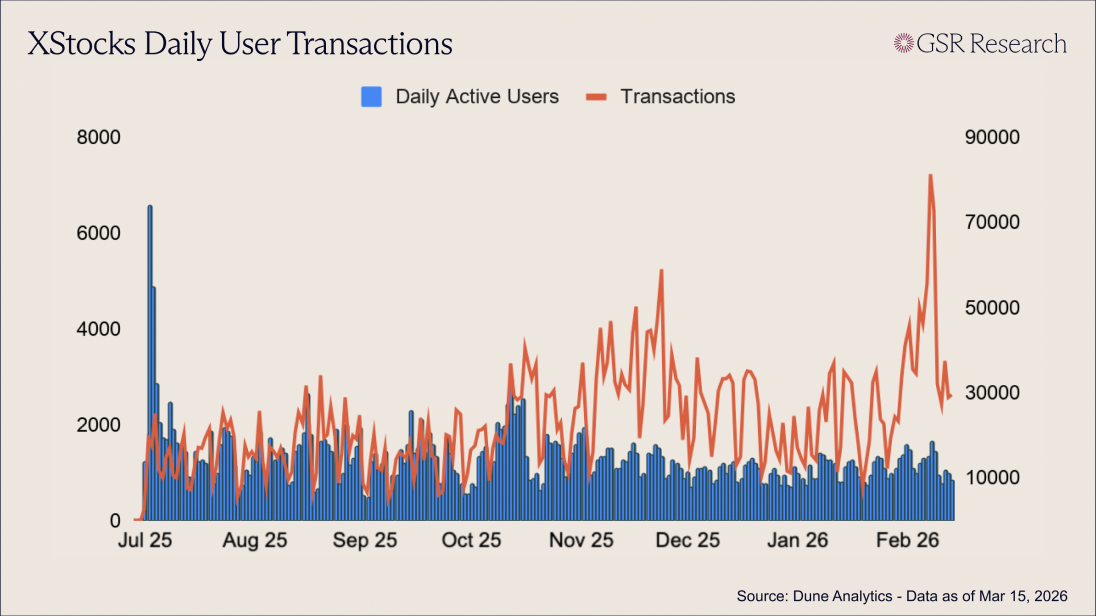
From a user-adoption perspective, the xStocks platform has maintained roughly 1,500 daily active users since launch, but the nature of that activity has changed substantially. The transactions-per-user ratio initially held steady at around 10:1 before climbing to 30:1 in November 2025 following Kraken's rollout of Unified Margin systems, which allowed users to deploy xStocks as collateral for perpetual futures and margin positions. The ratio spiked to 52:1 on February 6, 2026, during a sharp tech sector selloff that triggered automated rebalancing across the platform. This shift from simple directional trading toward active collateral management suggests that xStocks has developed a sticky user base treating tokenized equities as core financial infrastructure, a dynamic that the NASDAQ partnership, with its promise of legitimate equity backing, should only reinforce.
Last week marked two notable milestones for blockchain privacy. On Thursday, GSR and Zama completed the first confidential OTC trade on Ethereum using Zama's fully homomorphic encryption (FHE) protocol, executing a trade where sensitive details like trade size and counterparty flows remained encrypted throughout the entire lifecycle. The trade was conducted between fully KYC-compliant counterparties, demonstrating that onchain confidentiality and regulatory compliance can coexist on the same ledger. Days earlier, StarkWare announced the STRK20 token framework, which will allow any ERC-20 token on Starknet to support shielded balances and private transfers using zero-knowledge proofs, with composability across DeFi applications preserved. These developments are part of the ongoing acceleration in the long-running effort to bring privacy to programmable blockchains.
Confidentiality remains a critical missing link for programmable public blockchains. For institutions, trading on a fully transparent ledger means exposing position sizes, treasury movements, and strategic intent to the entire market, a structural cost that keeps traditional capital on the sidelines. The lack of privacy is also a significant barrier for mainstream retail adoption. On a blockchain-native financial system without privacy, anyone could inspect a salary, track spending habits, and reconstruct an entire economic profile from a single wallet address. The market's recognition of this problem was a key driver behind Zcash's historic rally last year, as investors priced in the growing consensus that privacy is essential plumbing.
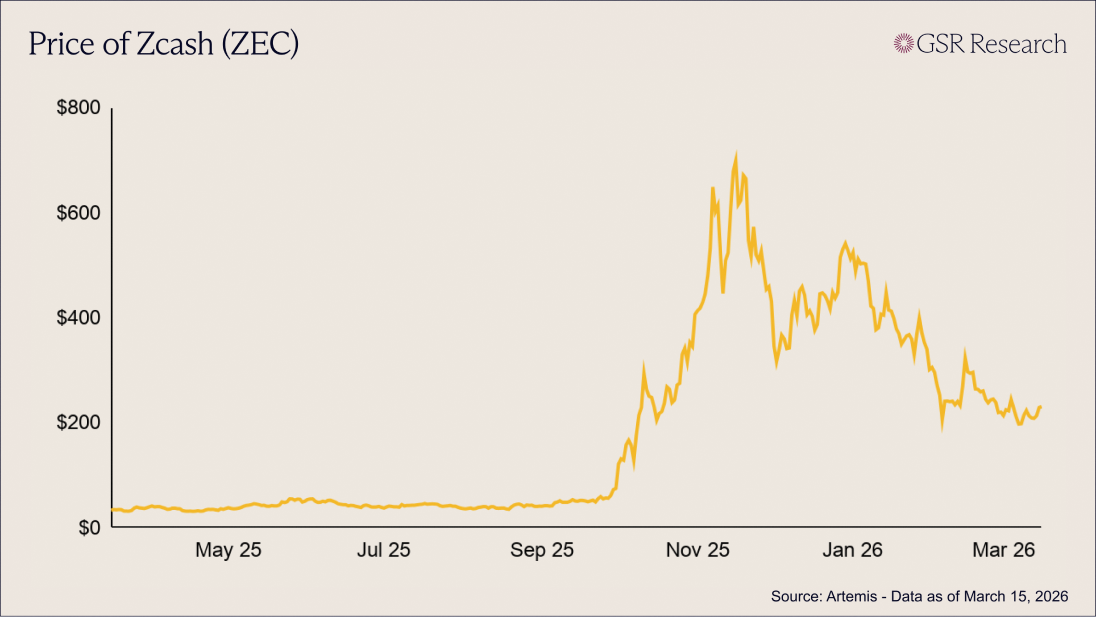
But Zcash, along with Monero and other privacy-focused chains, is limited to payments and value transfer. The harder problem, and the one these recent developments address, is implementing privacy on fully programmable smart contract platforms where the bulk of onchain economic activity occurs. This is where the privacy gap is most acute.
Three broad cryptographic approaches are being pursued, each with distinct tradeoffs. Zero-knowledge proofs allow a party to prove the correctness of a computation without revealing the underlying data. Starknet's STRK20 framework uses this approach, leveraging the chain's native ZK architecture to embed privacy directly at the token level, with client-side proof generation and sub-five-second settlement at costs below $0.20 per transaction. STRK20 also includes encrypted viewing keys that can be shared with authorized regulators or auditors when legally required, enabling selective disclosure without compromising default confidentiality. Aztec, which launched its decentralized Ignition Chain on Ethereum mainnet in late 2025, takes a more ambitious approach as a dedicated privacy-first L2, offering developers programmable privacy across both public and private smart contract logic using its Noir programming language. Aztec's architecture supports integrations with identity solutions like zkPassport, allowing users to prove compliance attributes (such as jurisdiction or accreditation status) without revealing their identity. Payy, which launched its Ethereum L2 in early February, focuses more narrowly on enabling private ERC-20 transfers through automatic privacy pools with embedded compliance capabilities. The primary challenge for ZK-based systems is the computational overhead of proof generation, particularly on the client side (e.g., on browsers and mobile), where generating proofs for complex operations can introduce latency and require meaningful device resources.
Fully homomorphic encryption takes a fundamentally different approach by allowing computations to be performed directly on encrypted data without ever decrypting it. Zama's protocol, which powered the GSR trade, uses a coprocessor architecture where FHE operations are offloaded from the host chain to a network of specialized nodes, avoiding the need to modify the base chain. Critically, Zama's access control system makes confidentiality fully programmable at the application level: developers can define exactly who is authorized to decrypt which values within a contract, allowing applications to enforce compliance rules natively in their smart contract logic rather than relying on external gatekeepers. Zama currently achieves around 20 transactions per second on CPU and targets 500-1,000 TPS on GPUs by the end of 2026, with dedicated ASICs planned further out. Inco and Fhenix are building similar FHE-based confidentiality layers. The main limitation remains raw throughput: encrypted computation is significantly more expensive than plaintext execution, and while hardware acceleration is narrowing the gap, FHE remains best suited today for high-value, lower-frequency operations like OTC settlement rather than mass-market retail transactions.
Secure multiparty computation (MPC) offers a third path, enabling multiple parties to jointly compute over shared encrypted inputs without any single party seeing the underlying data. Arcium, launching on Solana, uses MPC-based execution environments to enable what it calls ‘shared private state’, where confidential logic can run across multiple participants. TACEO combines MPC with zero-knowledge proofs through a novel primitive called coSNARKs, enabling collaborative computation over encrypted data with verifiable outputs. MPC's strength lies in multi-party workflows like dark pools and collaborative analytics, but communication overhead between nodes remains a scaling bottleneck, particularly as the number of participants grows.
A common misconception is that onchain privacy is inherently at odds with regulatory compliance, useful only for illicit activity. The reality is closer to the opposite. The aforementioned solutions are being designed from the ground up with compliance as a core requirement. The key insight is that confidentiality and auditability are not mutually exclusive. Through mechanisms like selective disclosure, viewing keys, and programmable access controls, these systems can keep transaction data private from the general public while remaining fully auditable by authorized parties. This is, in fact, how traditional finance already works: your bank doesn't broadcast your account balance to the world, but regulators can access your records when warranted. The new generation of blockchain privacy tools is building toward the same model with cryptographic guarantees instead of institutional trust.
These approaches are also not mutually exclusive. In practice, many teams are converging on hybrid designs. Arcium's execution environments blend MPC with both ZK and FHE components. TACEO's coSNARKs fuse MPC with zero-knowledge verification. The eventual privacy stack for public blockchains will likely combine elements of all three, with ZK handling proof generation and verification, FHE enabling encrypted computation, and MPC coordinating multi-party workflows. Different applications may lean on different primitives depending on their requirements: a confidential stablecoin transfer has different performance and trust assumptions than a multi-party dark pool or a private governance vote. The landscape remains early and the performance constraints are real, but the progress over the past year has been substantial, bringing practical privacy on smart contract blockchains closer to being a near-term reality.
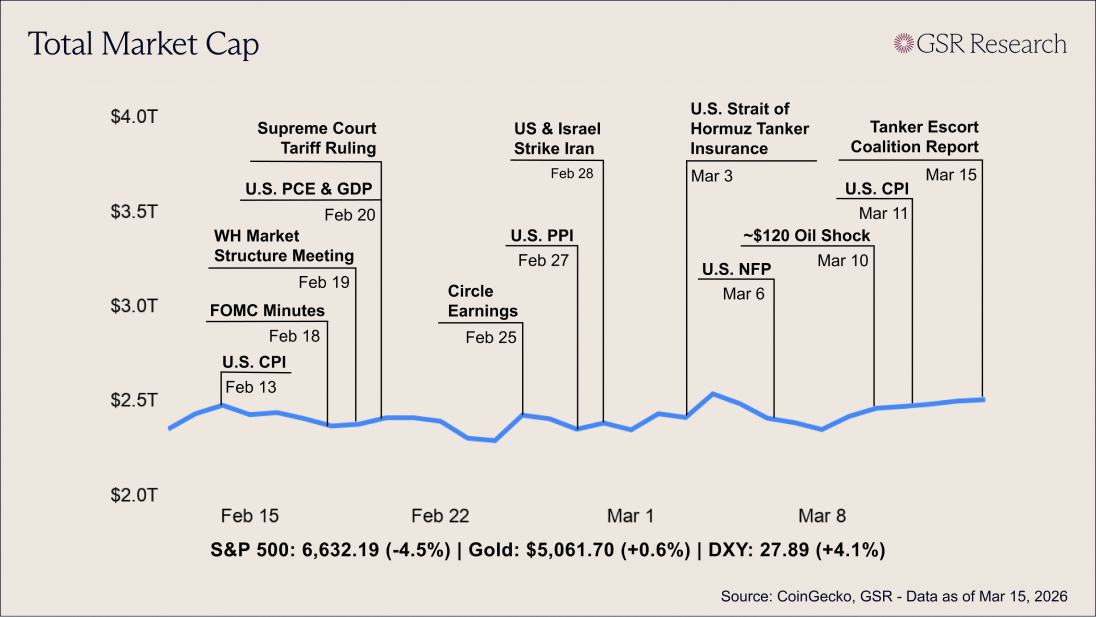
Crypto markets experienced another volatile week as the escalating Iran war, a historic oil supply crisis, and a barrage of economic data created a complex macro backdrop, yet Bitcoin emerged as one of the week's strongest performers, increasingly decoupling from equities and exhibiting safe-haven characteristics. The total market cap opened the week near $2.36T before climbing above $2.45T by the weekend, with Bitcoin rallying from roughly $66,800 to above $74,000, matching its early-March high. The S&P 500, by contrast, fell 1.6% on the week and posted its first three-week losing streak in about a year, closing at 6,632, a new low for 2026.
The dominant force throughout the week remained the Strait of Hormuz crisis. With daily transits down from a pre-war average of 138 ships to fewer than five since Iran declared the waterway closed, oil prices swung violently. Brent crude spiked to nearly $120 per barrel early Monday before crashing 17% on Tuesday to below $80 after Energy Secretary Chris Wright posted, then quickly deleted, a claim that the U.S. Navy had escorted a tanker through the strait. The White House later confirmed no armed escort had taken place. Markets stabilized briefly on Wednesday after the IEA announced the largest emergency oil reserve release in its history: 400 million barrels from its 32 member countries, more than double the 182.7 million barrels released following Russia's invasion of Ukraine. The U.S. committed to contributing 172 million barrels from the Strategic Petroleum Reserve. However, crude quickly resumed its climb as the market concluded that reserves alone cannot substitute for reopening a corridor that normally carries 20 million barrels per day. By Friday, WTI settled at $98.71 and Brent at $103.14, with both benchmarks continuing to climb over the weekend as no diplomatic resolution appeared imminent and Trump's call for an international naval coalition to reopen the strait was met with limited support.
On the data front, the February CPI report released Wednesday offered a mixed picture. Headline CPI came in at 2.4% YoY, unchanged from January, while core CPI slowed to 2.5% YoY, the lowest pace in nearly five years. Under normal circumstances, the print would have been modestly constructive for risk assets and supportive of future Fed easing. But the data was collected entirely before the Iran war began, rendering it largely backward-looking. Analysts noted that the subsequent energy price shock had already made the numbers obsolete. Friday's data releases reinforced the stagflationary picture. January PCE, the Fed's preferred inflation gauge, showed slight improvement at 2.8% YoY versus 2.9% in December, but the University of Michigan's preliminary March consumer sentiment reading fell to 55.5, a three-month low, as households reacted to surging gasoline prices. The survey director noted that sentiment gains observed before February 28th were completely erased by responses collected after the Iran conflict began. Year-ahead inflation expectations stalled at 3.4%, ending six months of consecutive declines.
Despite the challenging macro environment, Bitcoin's resilience stood out. While equities sold off and risk appetite deteriorated, BTC rallied roughly 10% over the course of the week, outperforming the S&P 500, Nasdaq, and gold. The rally accelerated on Thursday evening after Treasury Secretary Bessent signaled the administration was taking steps to ease oil prices, and extended into Friday as BTC pushed through $72,000 and briefly touched $74,000. The rally also unfolded alongside a succession of positive crypto-native catalysts. On Tuesday, the SEC and CFTC signed a historic Memorandum of Understanding establishing a Joint Harmonization Initiative to coordinate digital asset regulation, formalizing the agencies' intent to align product definitions and enforcement through joint interpretations and rulemaking. Meanwhile, senators reported progress toward a stablecoin yield compromise that could unlock the stalled CLARITY Act. And on Thursday, BlackRock launched ETHB, its first crypto ETF to incorporate staking, which debuted with $107 million in seed assets and $15.5 million in first-day trading volume. While the geopolitical backdrop dominated price action, the improving regulatory infrastructure continued to build a constructive medium-term foundation.
All eyes now turn to the FOMC meeting on March 17-18, which carries outsized significance. While a hold at 3.50%-3.75% is all but certain (CME FedWatch shows a 99%+ probability), this is a quarterly projection meeting that will feature the updated dot plot and Summary of Economic Projections, and the first time the Fed must formally incorporate the Iran oil shock and its inflationary implications into its official forecasts. Any shift in the dot plot from the current median of one 25bp cut for 2026 will be the primary market mover. Adding another layer of uncertainty, Jerome Powell's term as Fed Chair expires in May, making his commentary at this meeting particularly closely watched. Historically, Bitcoin has retraced following seven of the last eight FOMC meetings, suggesting traders should brace for potential volatility regardless of the outcome.
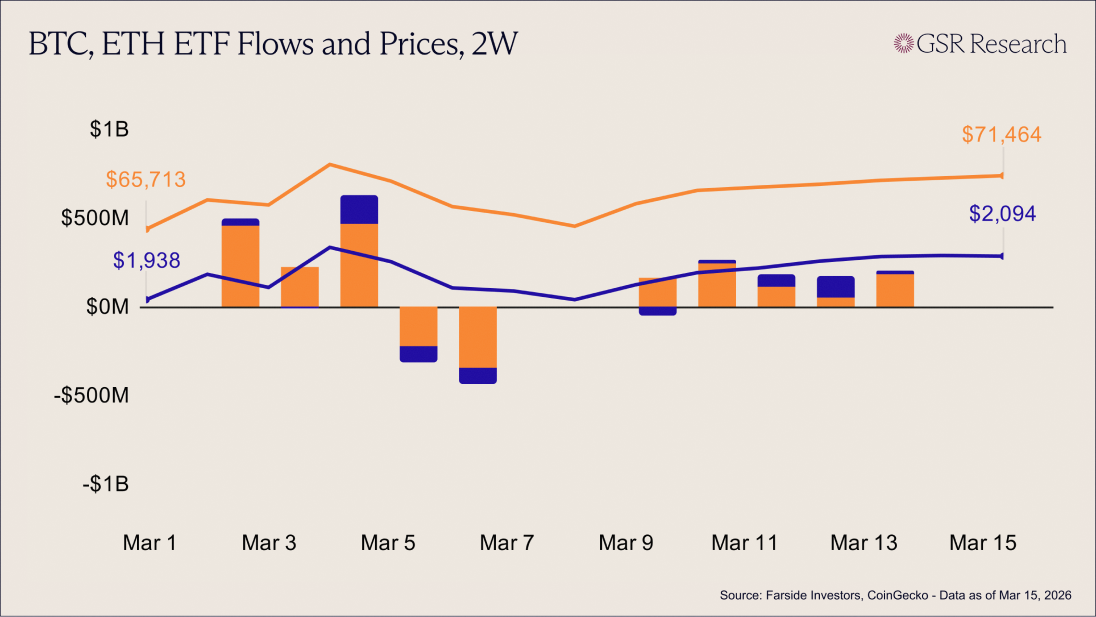
U.S. spot Bitcoin ETFs ETF flows remained exceptionally resilient this week, maintaining positive momentum across every single session. This marks the first entirely green trading week for net BTC ETF flows since late September 2025, finally breaking the cycle of midweek sell-offs that has haunted the market since the October 10th liquidation cascade. The week started with significant creations on Monday (+$167M) and Tuesday (+$247M) as geopolitical relief sparked a broad risk-on bid. Unlike previous weeks where the tide turned late in the session, institutional demand held firm through the midweek chop (+$115M and +$54M) before a final Friday surge (+$180M) capped off the run. This rare five-day sweep successfully defied typical weekend caution, leaving the weekly net at a robust +$763M.
ETH ETFs mirrored the broader market’s recovery, though the path was slightly more turbulent at the start of the week. The overall five-day performance was salvaged by a massive influx of capital on Thursday (+$116M), which effectively neutralized a shaky Monday opening of -$51M. Buoyed by steady, climbing interest on Tuesday and Wednesday, and a final positive push on Friday, Ether funds closed the week with a strong aggregate net flow of +$161M. Prices have been cautiously positive over the past 2 weeks, as Bitcoin has surged from $65.7k to $71.5k (+8.75%), while Ether has climbed from $1,938 to $2,094 (+8.05%). Both assets have finally broken out of their previous ranges, indicating that consistent institutional bidding has finally begun to outweigh broader market inertia.
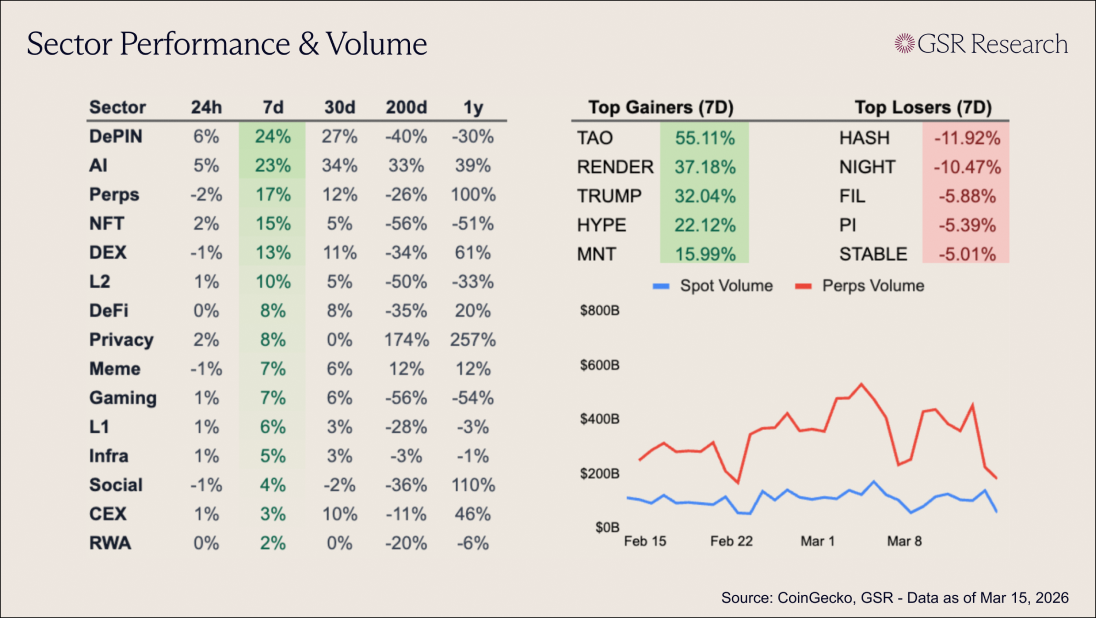
The consistent gains in majors resulted in a broad price appreciation across altcoin markets as all sectors are positive on the week. DePIN is the category leader, up 24% due to rallies in TAO (+55%) and Render (+37%), which are this week's top performers. Bittensor’s price appreciation was ignited by the successful completion of the largest decentralized LLM pre-training run in history on the Templar subnet. Simultaneously, Render gained in value as generalized demand for decentralized GPU compute spiked with the Agentic AI narrative intensifying.
The perpetuals sector rallied 17% this week, as HYPE (+22%) was once again among the top gainers. Hyperliquid remains the dominant perpetual platform by all metrics as steady HIP-3 volumes and the prospective HIP-4 launch continue to result in enhanced speculation.
This material is provided by GSR (the “Firm”) solely for informational purposes. It is not intended to be advice or a recommendation to buy, sell or hold any investment mentioned. Investors should form their own views in relation to any proposed investment.
It is intended only for sophisticated, institutional investors and does not constitute an offer or commitment, a solicitation of an offer or commitment, or any advice or recommendation, to enter into or conclude any transaction (whether on the terms shown or otherwise), or to provide investment services in any state or country where such an offer or solicitation or provision would be illegal. The Firm is not and does not act as an advisor or fiduciary in providing this material.
This material is not an independent research report, and has not been prepared in accordance with any legal requirements by any regulator (including the FCA, FINRA or CFTC) designed to promote the independence of investment research.
This material is not independent of the Firm’s proprietary interests, which may conflict with the interests of any counterparty of the Firm. The Firm may trade investments discussed in this material for its own account, may trade contrary to the views expressed in this material, and may have positions in other related instruments. The Firm is not subject to any prohibition on dealing ahead of the dissemination of this material.
Information contained herein is based on sources considered to be reliable, but is not guaranteed to be accurate or complete. Any opinions or estimates expressed herein reflect a judgment made by the author(s) as of the date of publication, and are subject to change without notice. The Firm does not plan to update this information.
Trading and investing in digital assets involves significant risks including price volatility and illiquidity and may not be suitable for all investors. The Firm is not liable whatsoever for any direct or consequential loss arising from the use of this material. Copyright of this material belongs to GSR. Neither this material nor any copy thereof may be taken, reproduced or redistributed, directly or indirectly, without prior written permission of GSR.
Please see here for additional Regulatory Legal Notices relevant to US, UK and Singapore.