Treasury Management Beyond The Bull Market With Spencer Hallarn - Global Head of Markets

Spencer Hallarn
Head of Markets

Slater Santer
Research Analyst

Spencer Hallarn
Head of Markets
Slater Santer
Research Analyst
At GSR, we've seen the same story play out across every market cycle.
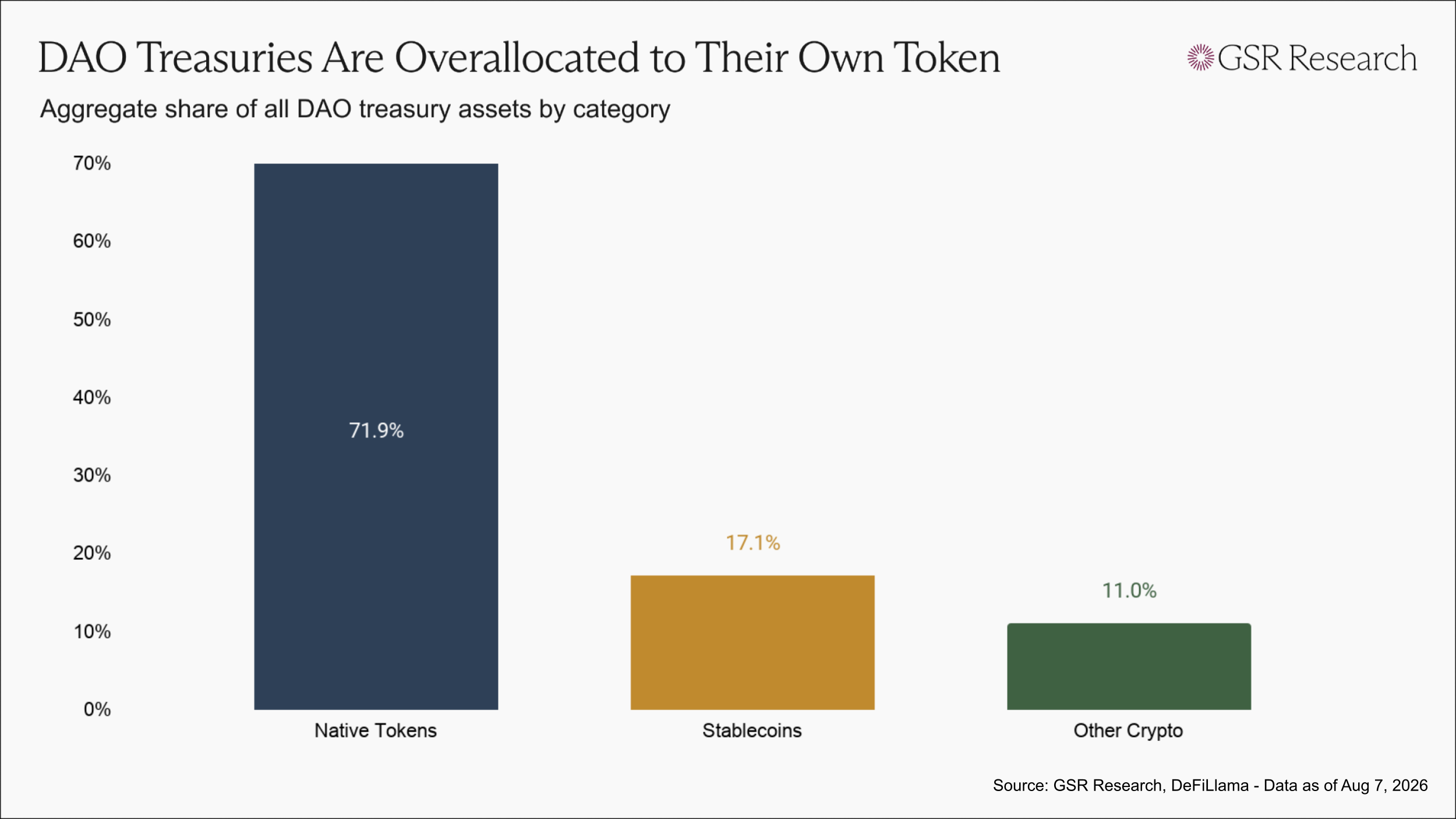
Crypto treasuries are procyclical by construction, as most DAO treasuries remain heavily concentrated in their native token. In aggregate, over 70% of treasury assets are held in the project's own token, with relatively little allocated to stable assets or diversified reserves.
We see the consequences of this allocation every downturn.
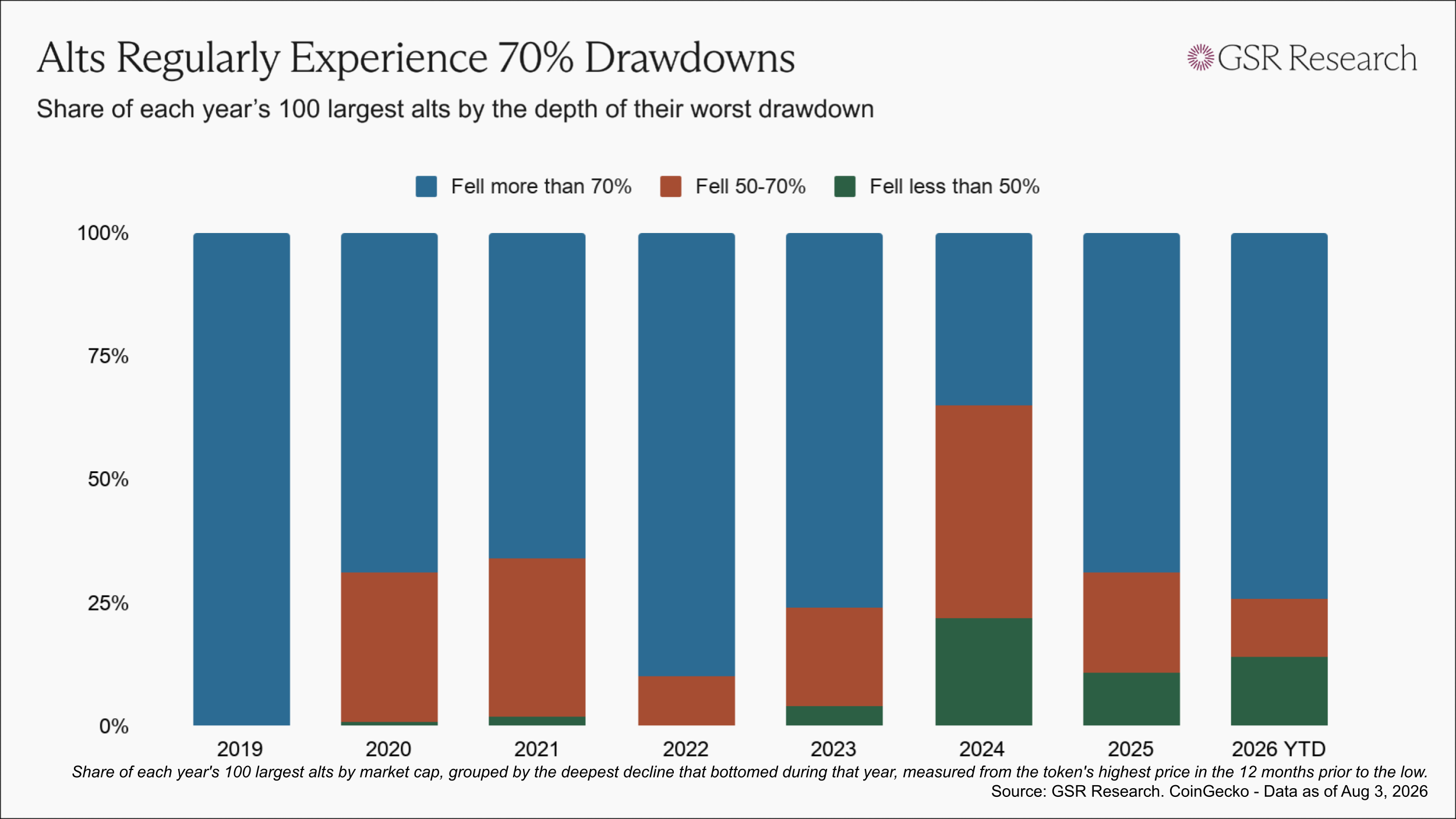
When the cycle turns and the token’s price drops, the treasury that was meant to fund the roadmap suddenly becomes the project's biggest source of risk.
Given the current climate, that is a conversation we are having with more clients than ever. We are suddenly asked not only when the market will recover, but whether a project will have enough runway to keep building until it does.
The second challenge is structural.
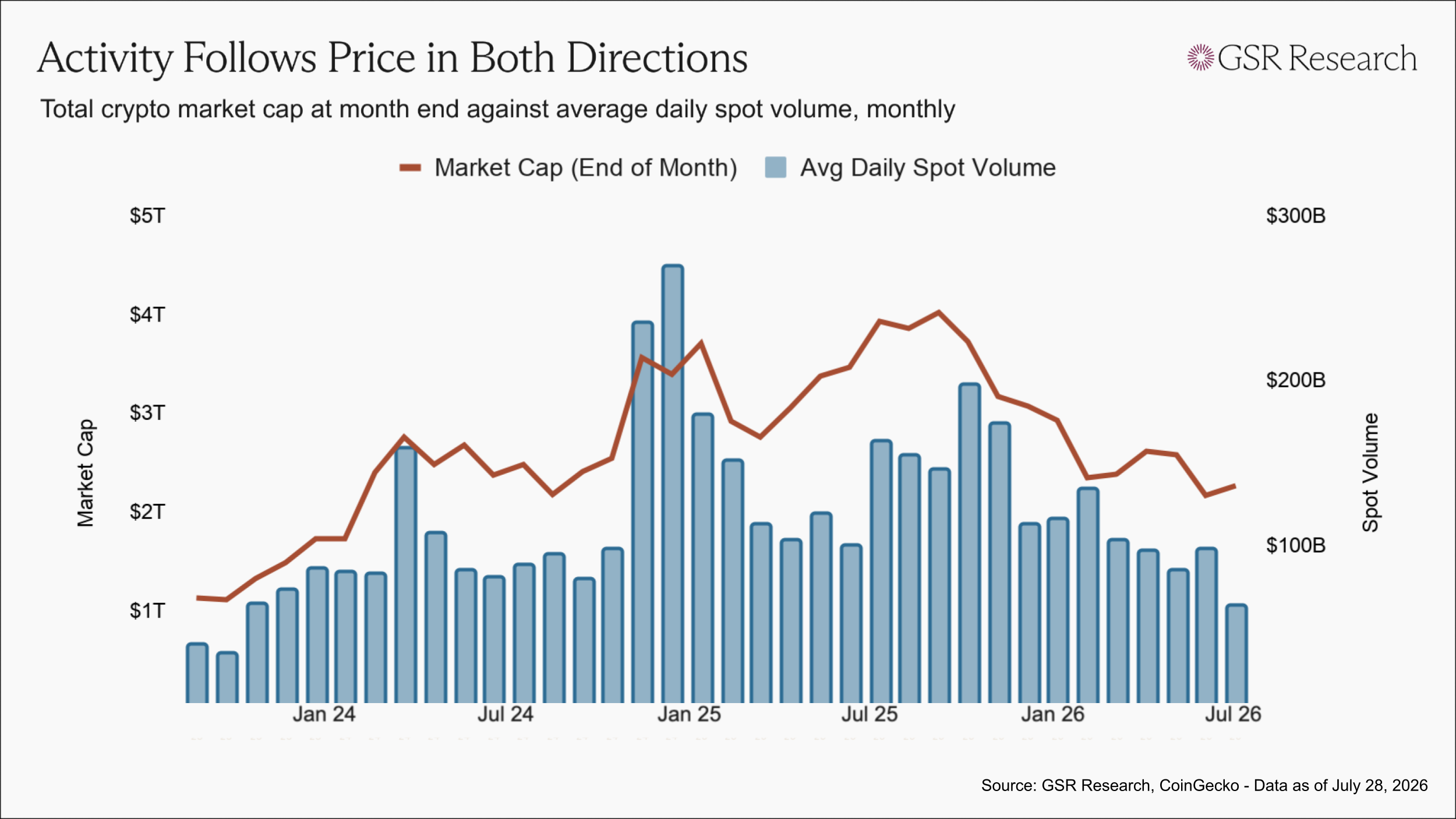
As treasury value falls, protocol activity weakens, fee generation slows, and liquidity deteriorates at the same time. The treasury becomes least valuable at the exact moment it is needed most.
We see this play out across cycles. Teams believe they have a treasury that will support them through difficult markets, but both sides of their balance sheet are exposed to the same underlying risk.
Costs do not fall with the token. Payroll, audits, infrastructure, and grants are denominated in dollars, so a project funding them from token sales has to sell more tokens to raise the same amount. Selling more supply into a weaker market pushes the price lower again, which raises the number of tokens needed next quarter. The treasury drains faster than the drawdown alone would suggest.
That is why we start with a simple question with every client: Could your treasury fund the roadmap if markets declined for another 12 months?
This is a clear pattern we’ve observed on our OTC desk.
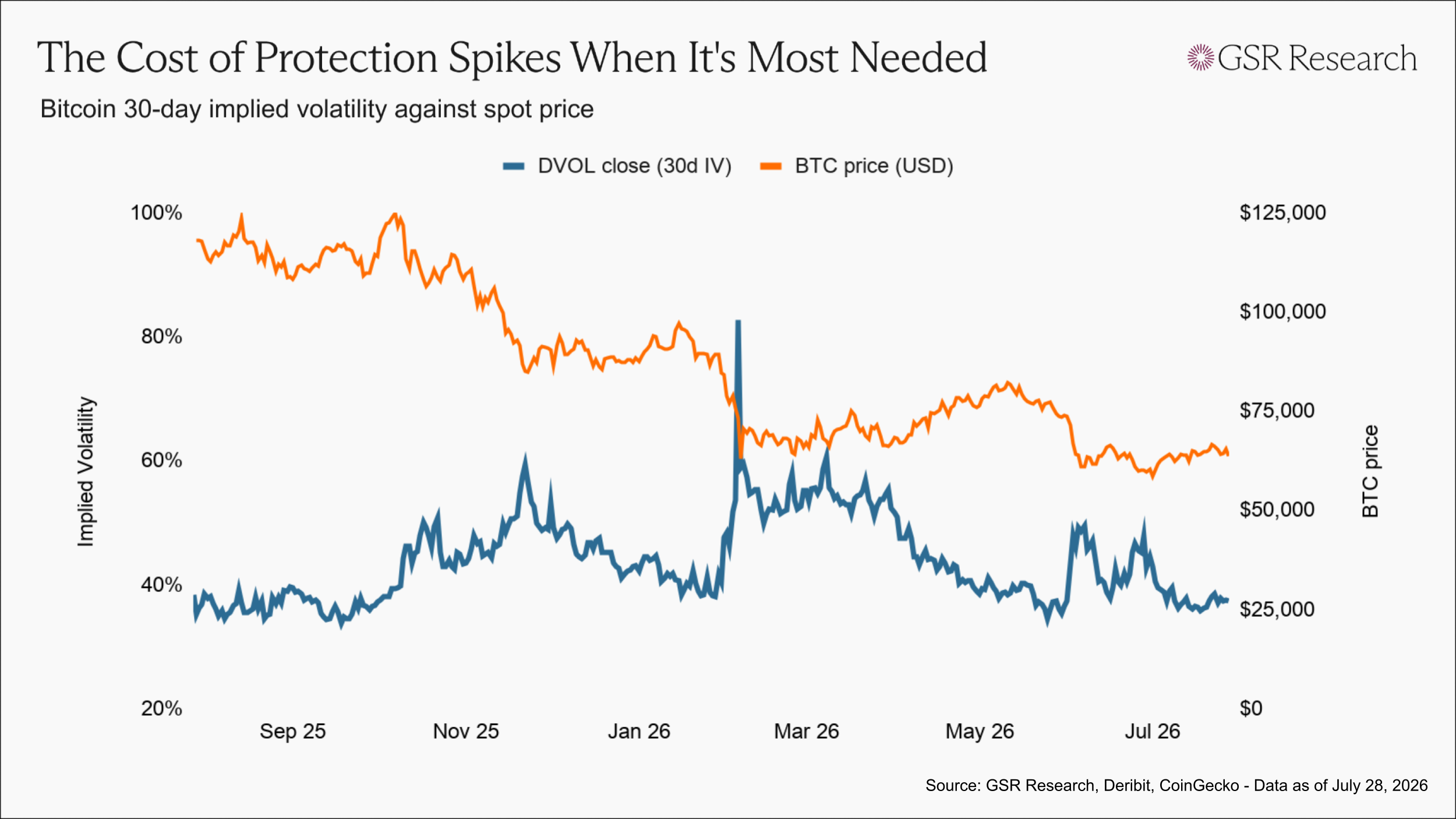
During bull markets, very few projects want to hedge, as paying option premium feels like sacrificing upside. Then markets sell off, and the conversation changes almost overnight. Suddenly everyone wants protection.
Unfortunately, that is also when protection is most expensive.
As shown above, implied volatility typically rises after markets fall, increasing the cost of downside protection precisely when demand is highest. It is the financial equivalent of buying insurance while the storm is already overhead.
We have seen this story time and time again. Every client wishes they had hedged when volatility was low. None of them can go back and do it.
Hedging should be viewed as an ongoing treasury policy, not a last-minute call made out of fear. You don’t need to predict where prices will go next, only ensure that known liabilities can be funded regardless of what markets do.
There is also more than one way to pay for it. As crypto’s volatility is generally expensive compared to traditional assets, the structure we execute most often is a collar. Projects sell a call above the current price and use the premium received to buy a put below it. Ultimately, this gives the project’s token a defined range. Value is protected below the put strike, and in exchange the project gives up gains above the call strike. Structured properly, the two legs offset each other and the trade can be done costlessly. This makes collars the hedging tool of choice for many projects, as buying puts outright spends the same reserve the hedge exists to protect.
A collar is not a sale, as projects keep exposure inside a range they choose. It gives up the gain above the call strike in exchange for a known floor. Collars turn a volatile asset into a range your finance team can plan around when dollar costs are budgeted for a year in advance.
None of this removes the case for acting early. A collar is a tool that protects from wherever the token trades on the day it is put on. A project that sets a floor with its token at $10 protects most of its value. A project that waits until the token is at $4 sets its floor near $4. The structure is available in both cases, but it cannot recover what has already been lost.
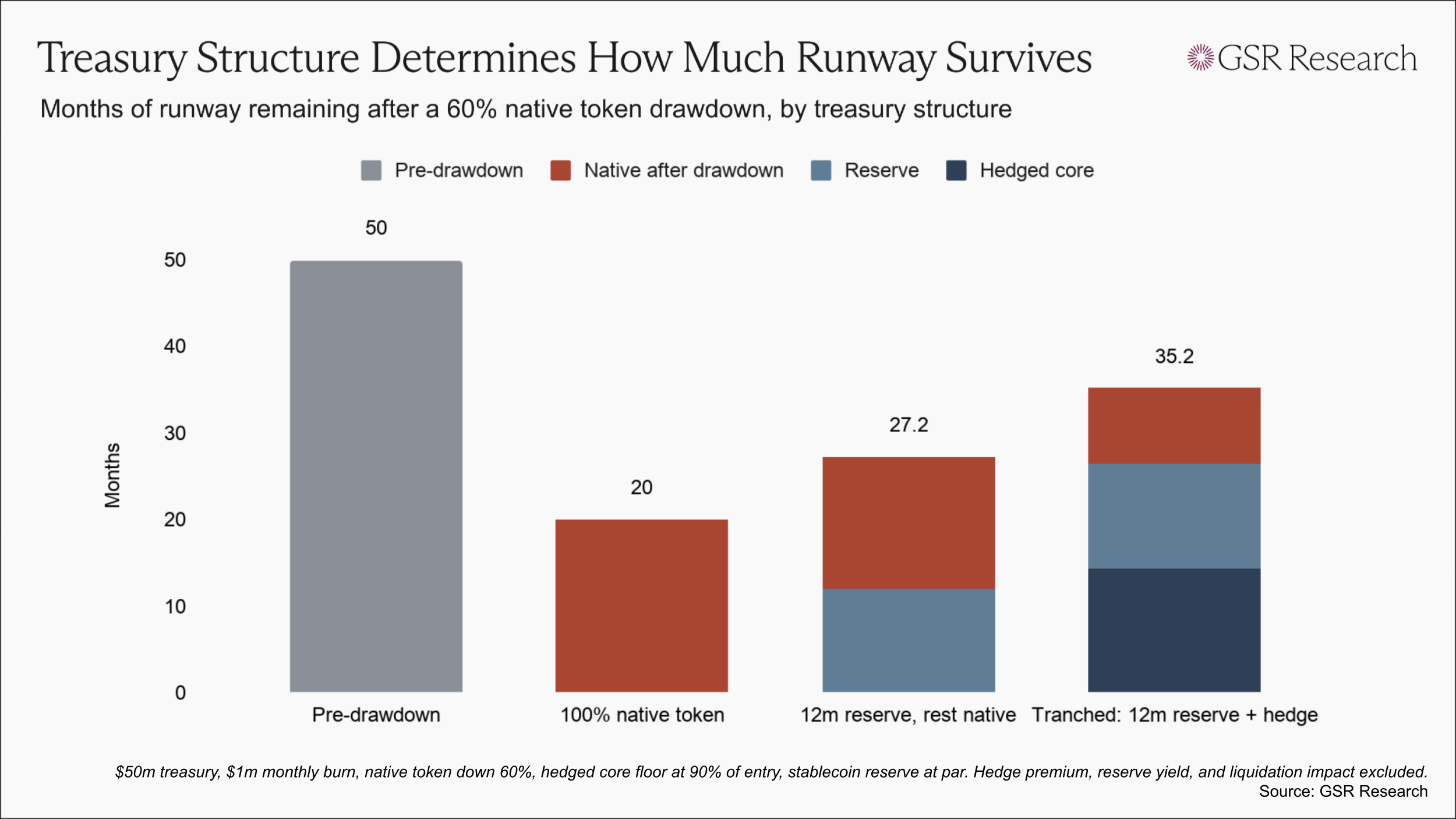
The projects that have successfully navigated multiple cycles all have separate parts of their treasuries, each with a defined purpose.
Operating reserves are held in cash or stable assets to fund payroll and operating expenses. Longer-term crypto holdings remain invested but are managed with appropriate hedging where necessary. Strategic positions remain intact without putting the organization's survival at risk.
The chart above illustrates the difference. A treasury held entirely in a native token can lose years of operating runway during a major drawdown. Separating reserves and protecting longer-term holdings preserves substantially more runway, even before assuming any market recovery.
Preserve first. Grow second.
This is where we spend our time.
Every treasury is different. Liquidity, governance structures, vesting schedules, operating budgets, jurisdictional constraints, and token concentration all influence how a treasury can be structured and the risks and trade-offs involved.
GSR works with foundations, DAOs, and protocols across OTC execution, collars and other customized derivatives, structured hedging programs, and block trading. These transactions can be used to manage treasury concentration, market exposure, and liquidity depending on the circumstances of the relevant treasury.
GSR's activity in these markets includes both execution and the structuring of treasury transactions across different market conditions.
Our industry remains cyclical. The projects that emerge strongest will be the ones that never had to stop building, because their treasuries were built to survive the downturns.
This material is provided by GSR (the “Firm”) solely for informational purposes. It is not intended to be advice or a recommendation to buy, sell or hold any investment mentioned. Investors should form their own views in relation to any proposed investment.
It is intended only for sophisticated, institutional investors and does not constitute an offer or commitment, a solicitation of an offer or commitment, or any advice or recommendation, to enter into or conclude any transaction (whether on the terms shown or otherwise), or to provide investment services in any state or country where such an offer or solicitation or provision would be illegal. The Firm is not and does not act as an advisor or fiduciary in providing this material.
This material is not an independent research report, and has not been prepared in accordance with any legal requirements by any regulator (including the FCA, FINRA or CFTC) designed to promote the independence of investment research.
This material is not independent of the Firm’s proprietary interests, which may conflict with the interests of any counterparty of the Firm. The Firm may trade investments discussed in this material for its own account, may trade contrary to the views expressed in this material, and may have positions in other related instruments. The Firm is not subject to any prohibition on dealing ahead of the dissemination of this material.
Information contained herein is based on sources considered to be reliable, but is not guaranteed to be accurate or complete. Any opinions or estimates expressed herein reflect a judgment made by the author(s) as of the date of publication, and are subject to change without notice. The Firm does not plan to update this information.
Trading and investing in digital assets involves significant risks including price volatility and illiquidity and may not be suitable for all investors. The Firm is not liable whatsoever for any direct or consequential loss arising from the use of this material. Copyright of this material belongs to GSR. Neither this material nor any copy thereof may be taken, reproduced or redistributed, directly or indirectly, without prior written permission of GSR.
Please see here for additional Regulatory Legal Notices relevant to US, UK and Singapore.