GSR Weekly Update - July 20th, 2026
BTC: $64,530 (+0.6%) | ETH: $1,867 (+2.6%) | BTC Dom: 56.5% | Global Cap: $2.29T

Carlos Guzman
Research Analyst

Slater Santer
Research Analyst

BTC: $64,530 (+0.6%) | ETH: $1,867 (+2.6%) | BTC Dom: 56.5% | Global Cap: $2.29T
Carlos Guzman
Research Analyst
Slater Santer
Research Analyst
Last week Crypto.com announced a $400M strategic investment from Citadel Securities at a $20B valuation, marking the exchange’s first institutional funding round in its decade-long history. Crypto.com built its brand as a consumer super-app, claims more than 150M users globally, and ranks just 11th by trading volume, yet the raise announcement centers on tokenized securities and derivatives rather than the exchange’s spot market share. For Citadel Securities, whose core business is market making, the appeal is obvious: if traditional assets migrate onto always-open rails, the most valuable relationships will be with platforms capable of originating, routing, custodying, and settling cross-asset flow.
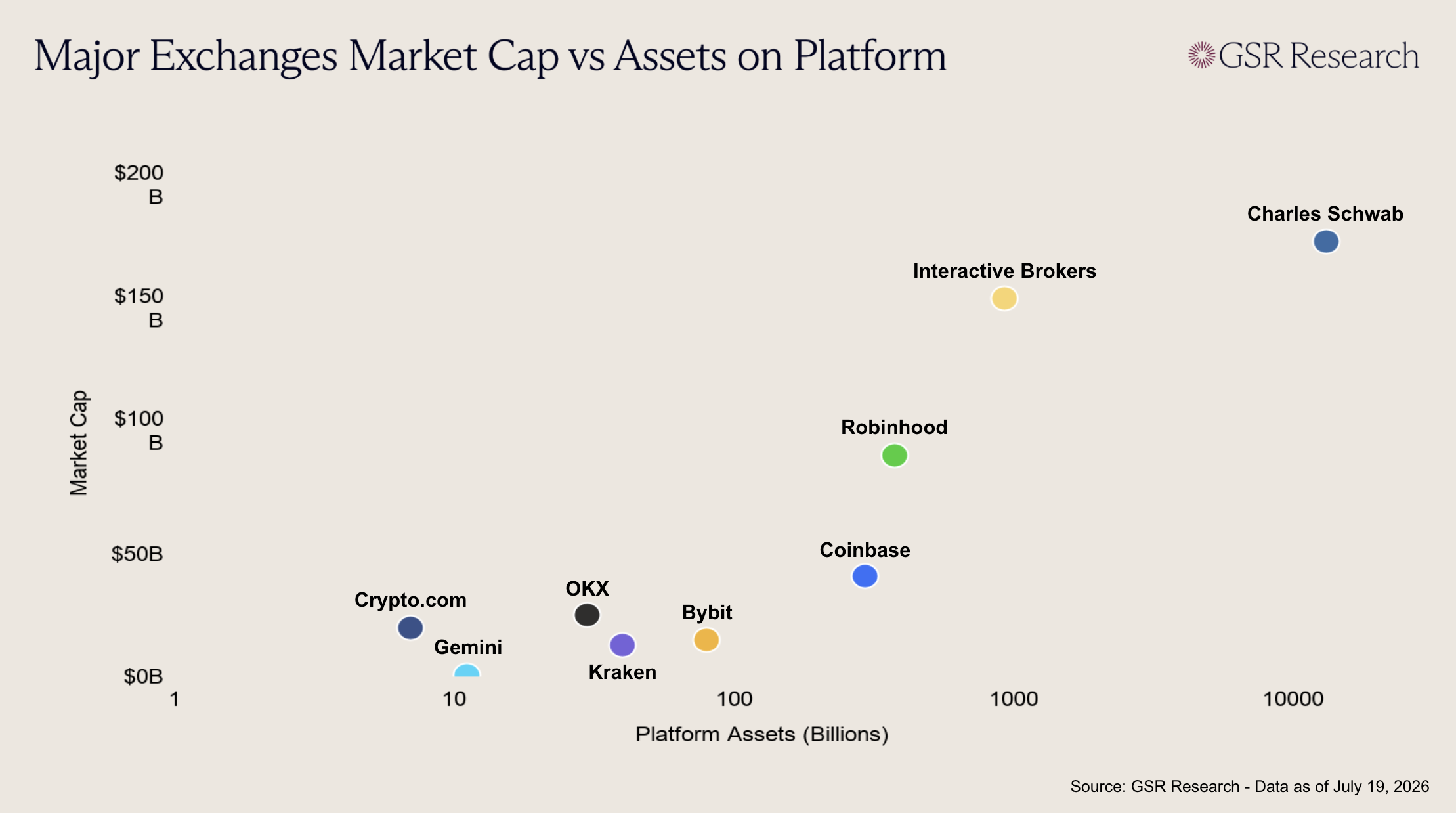
The simplest way to see how differently the market treats these platforms is to divide valuation by client assets. Charles Schwab holds roughly $13.1T in client assets against a $177B market cap, about 1 cent of valuation per dollar it oversees. Coinbase trades at 14 cents per dollar of platform assets, Robinhood at 24 cents, Kraken at 33 cents, and OKX and Bybit sit near a full dollar. Gemini, at 5 cents, is the outlier in the other direction, a crypto-native platform priced at a steep discount to peers. The gradient largely tracks monetization intensity: traditional brokers earn thin take rates on enormous, sticky asset pools, while crypto exchanges earn far higher take rates on smaller balances. This is primarily because derivatives constitute most centralized exchange trading activity (76.5% in March).
However, platform assets are not a complete valuation framework. Trading venues are often valued more on velocity, take rate, derivatives volume, and regulatory optionality than on static balances, which is why Citadel invested in Crypto.com despite $2.86 in valuation per dollar of client assets, the highest of all exchanges. Traditional brokers monetize enormous asset bases at lower implied multiples because their businesses are mature and slower growing. Crypto exchanges are being valued on the possibility that they become the 24/7 interface for trading, custody, lending, payments, derivatives, and tokenized securities. That is why private exchange valuations can look optically expensive relative to assets today, while still making sense if the platform(s) becomes a broader financial operating system.
The question remains, why would Citadel choose Crypto.com over larger or cheaper venues? Crypto.com is not a dominant exchange by volume or assets, but it may be one of the broadest private targets left for a strategic investor. The company claims more than 150M users globally, holds a MiCA license in Europe, secured a MiFID license to expand traditional investment services across the EEA, acquired SEC-registered broker-dealer Watchdog Capital, obtained a full stack of U.S. CFTC derivatives licenses, and received conditional OCC approval for a national trust bank charter. That combination gives Crypto.com exposure across payments, crypto trading, equities and options, derivatives, custody, and eventually tokenized securities under a growing regulatory umbrella.
That breadth likely explains why Citadel chose Crypto.com. Coinbase is public, expensive, and already heavily owned by institutions. Robinhood is public and pursuing its own brokerage-led tokenization strategy. Kraken is private, but Citadel already invested $200M into Kraken at a $20B valuation last year. Crypto.com offers something different: a global consumer app with super-app DNA, a growing regulatory stack, securities and derivatives ambitions, and private-market upside. Citadel is not necessarily picking one exchange winner, but buying exposure to a set of regulated venues that could matter if tokenized markets, perpetuals, stablecoin payments, and 24/7 trading become larger pieces of global market structure.
The timing may be the most interesting detail of this raise. The deal landed as the tokenization backdrop hardened, with DTCC running its first production trades of a tokenized asset service this month ahead of a full October launch, MiCA's transitional period ending July 1 and sharpening the divide between licensed and unlicensed venues in Europe, and the OCC clarifying that national banks can custody and execute crypto. A $400M exchange investment framed around tokenized securities would have looked speculative in 2022, but in the current environment it appears that Citadel is positioning for a market structure shift that is already underway. The raise also does not refute the onchain challenge so much as confirm it, as Hyperliquid's $60B valuation is proof that serious derivatives trading no longer requires centralized architecture, forcing centralized venues to justify their intermediation through regulation, custody, and distribution. Crypto.com's answer is to build the licensed, consumer-facing shell around that onchain future before pure onchain venues absorb it. If tokenized securities scale on schedule, the open question is whether they will settle through incumbent rails like the DTCC's or through always-on exchange stacks, and Citadel just spent $400M positioning for the second outcome.
Three weeks ago, Robinhood launched the public mainnet of its Robinhood Chain, pitching the network as the home for its new Stock Tokens and for tokenized real-world assets more broadly (we covered the launch here). CEO Vlad Tenev echoed that framing the day after launch, telling CNBC that assets without underlying utility do not serve a lasting purpose. Three weeks in, however, the chain has become one of the busiest networks in the industry, but the activity so far looks very different from what the company pitched initially.
The activity numbers Robinhood Chain is putting up are remarkable for a chain that has been around for such a short time. The network processed $3.1B in DEX volume during its first full week, peaking above 7 million daily transactions. Its trailing seven-day volume now sits near $4.5B per DeFiLlama, up more than 44% on the week. Notably, the overwhelming majority of that trading has been in memecoins, with RWA activity paling in comparison. At its peak the largest memecoin on the chain, CASHCAT, was alone worth about twelve times all the tokenized real-world assets on the network combined.
The memecoin frenzy run has been powered by a handful of pump.fun-style launchpads. Activity concentrated initially on the Noxa launchpad, where CASHCAT was launched (the memecoin is named after the working title Tenev and co-founder Baiju Bhatt used before settling on Robinhood). Noxa collected an estimated $12M in fees in under two weeks, then halted new launches, citing a flood of low-quality tokens, and went dark. Successor launchpads filled the void within days, and Uniswap has since shipped its own token launch tooling on the chain.
The memecoin frenzy on Robinhood Chain out of the gate is further notable given the chain has opted not to rely on the same incentive playbook that has driven early explosive growth in many previous chain launches. The main contrast with these is that the Robinhood doesn’t run a points program and the chain has no token to farm, so the usual airdrop motives are absent. Instead, the company did make speculation nearly free by covering gas costs under a 90-day subsidy and charging no commissions, lowering the barrier for users to execute transactions. But why memecoins? The activity concentration there may have a structural explanation. Stock Tokens, the chain's flagship product, are unavailable to users in the US, Canada, the UK, Switzerland, and the UAE, while the chain itself is permissionless and open to everyone. Thus, the main audiences that Robinhood brand has historically catered to and attracted, including US retail, arrived on a network where the only assets they could freely trade were the permissionless ones. Tenev quickly leaned in, posting six days after his CNBC comments that while the company is building the chain to be the best for RWAs, "it works great for memes too."
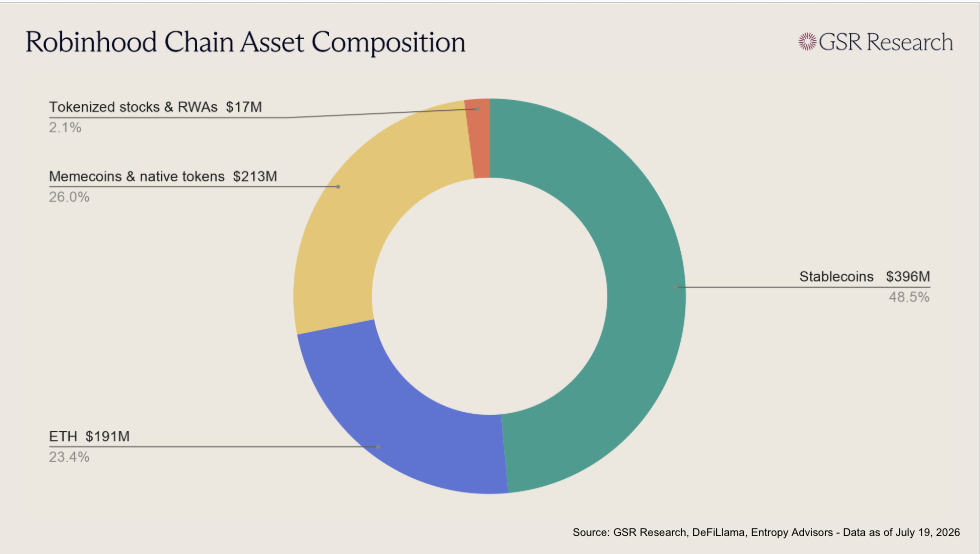
Beneath the memecoin churn, the assets the chain was designed to house have been accumulating steadily. Stablecoin supply sits near $396M, up 31% on the week, with USDG at roughly 75% dominance as Robinhood Earn's subsidized 7% yield pulls in deposits, including a $50M allocation from Ethena. Canonically bridged ETH adds another $191M. Tokenized stocks remain relatively small at around $17M in market cap, though it’s been growing steadily.
The pattern that appears to be emerging could mirror Robinhood's own history. The company built its user base by making stock and options trading feel like a feel easy and rewarding, drew years of regulatory criticism for it, and rode speculative waves like meme stocks and Dogecoin (which alone accounted for 62% of its crypto revenue in Q2 2021), before layering retirement accounts, banking, and wealth management on top of that foundation. The chain appears to be tracing the same arc in compressed form, with speculation supplying the users and the activity while the more durable products (stablecoin rails, Earn deposits, and a growing base of tokenized equities) accumulate underneath. The more meaningful test arrives in the fall, when the gas subsidy lapses and memecoin trading has to pay its own way. It remains to be seen if — once the mercenary volume rotates out — what remains is roughly the chain Robinhood set out to build in the first place.
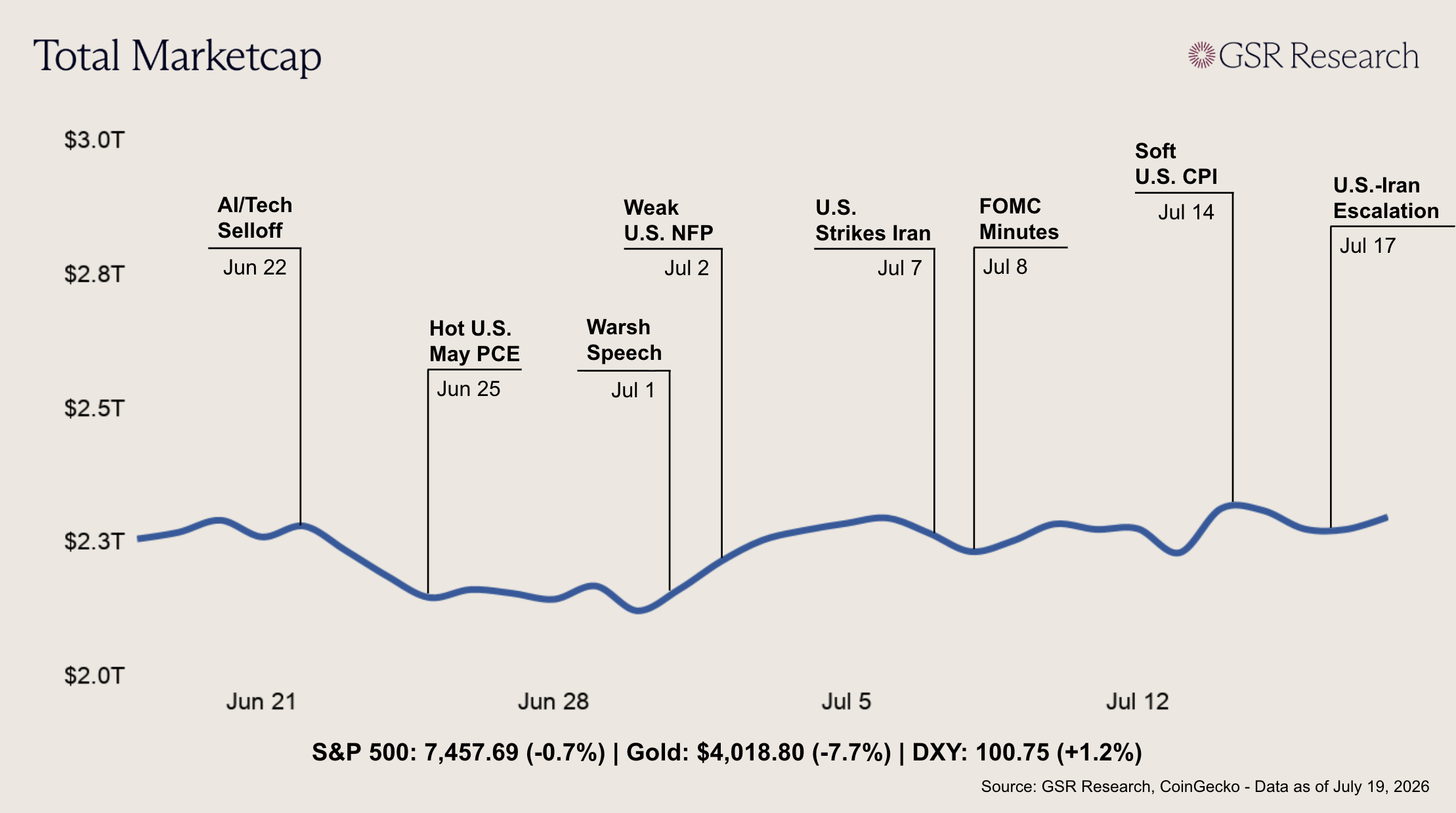
Crypto finished the week near where it started, with total market value around $2.29 trillion. An early rally on cooler inflation data faded as oil, war, and a falling stock market took over.
Investors started the week worried that the Fed might raise rates in late July, a real possibility after Kevin Warsh became chair in May and kept warning that prices were too high. Futures markets put the odds of a July hike at over 40% at the beginning of the week. Then, June U.S. CPI data showed consumer prices falling 0.4% last month, the biggest monthly drop since early 2020, and PPI data the next day showed a decline in wholesale prices, both getting some relief thanks to cheaper energy. While annual inflation is above target at 3.5%, the monthly figures eased the fear of a hike. Bitcoin climbed to a local high near $65,500 on July 15, and Ether rose more than 6% to about $1,880.
The mood turned in the back half of the week. Firmer data on retail sales, jobless claims, and factory activity pointed to an economy holding up well, which kept the door open to higher rates. The war between the United States and Iran escalated, with a seventh straight night of American strikes, Iranian counterattacks, and a renewed blockade near the Strait of Hormuz. Oil rose more than 11% on the week and revived worries about inflation. A sharp selloff in tech and AI stocks added to the pressure, and crypto fell alongside stocks. Hopes for Senate progress on the CLARITY Act, the bill to set clearer rules for digital assets, faded after several Democrats objected to its ethics provisions. Bitcoin slipped to around $63,900 and Ether to $1,840 by the weekend.
ETF Flows
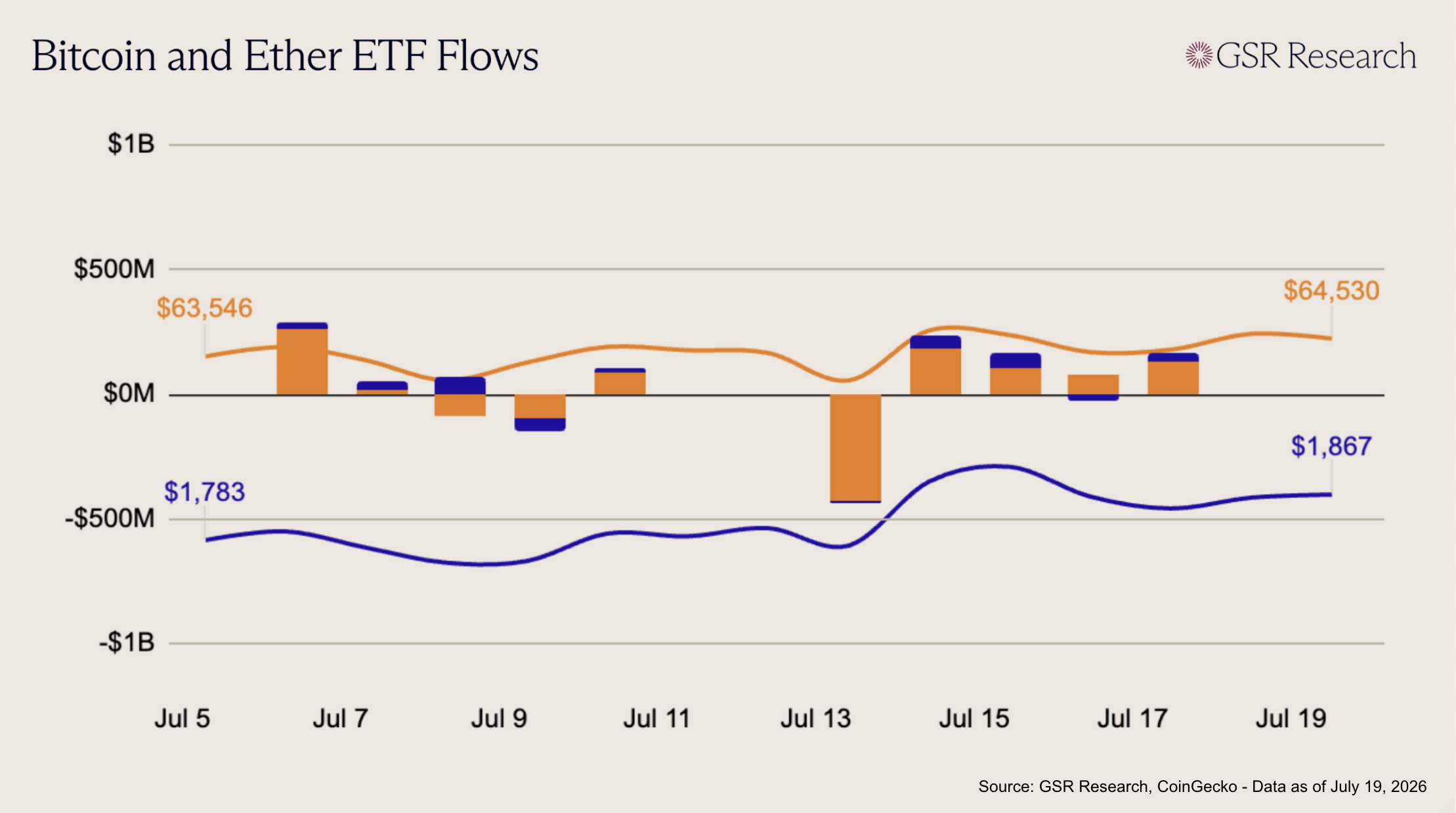
Spot Bitcoin ETFs finished modestly positive this week, though the path was uneven after a sharp opening outflow. The week began with a heavy redemption on Jul 13 (-$425M), driven primarily by outflows from IBIT (-$186M), FBTC (-$246M), and GBTC (-$53M), partially offset by BTC (+$53M). Flows then flipped decisively positive for the rest of the week, with inflows on Jul 14 (+$181M), Jul 15 (+$108M), Jul 16 (+$79M), and Jul 17 (+$132M). The recovery was led mainly by IBIT, which added roughly $390M across the final four sessions, while FBTC also provided support on Jul 14 through Jul 16. Across the week, BTC ETFs gained roughly $76M, indicating that demand has stabilized, though the large Monday outflow shows institutional conviction remains somewhat uneven.
Ether ETFs showed a more constructive flow profile this week, with positive sessions outweighing two smaller outflow days. The week opened with a modest redemption on Jul 13 (-$15M), driven entirely by FETH, before flows rebounded sharply on Jul 14 (+$58M) and Jul 15 (+$54M), led primarily by ETHA. A brief setback followed on Jul 16 (-$28M), driven by outflows from FETH, ETHE, and ETH, but the weakness was short-lived as Jul 17 returned to positive territory (+$37M). Across the week, ETH ETFs gained roughly $106M. While the flow profile was not perfectly consistent, ETH continues to show improving demand relative to the prior redemption cycle, with positive sessions carrying enough weight to offset intermittent weakness.
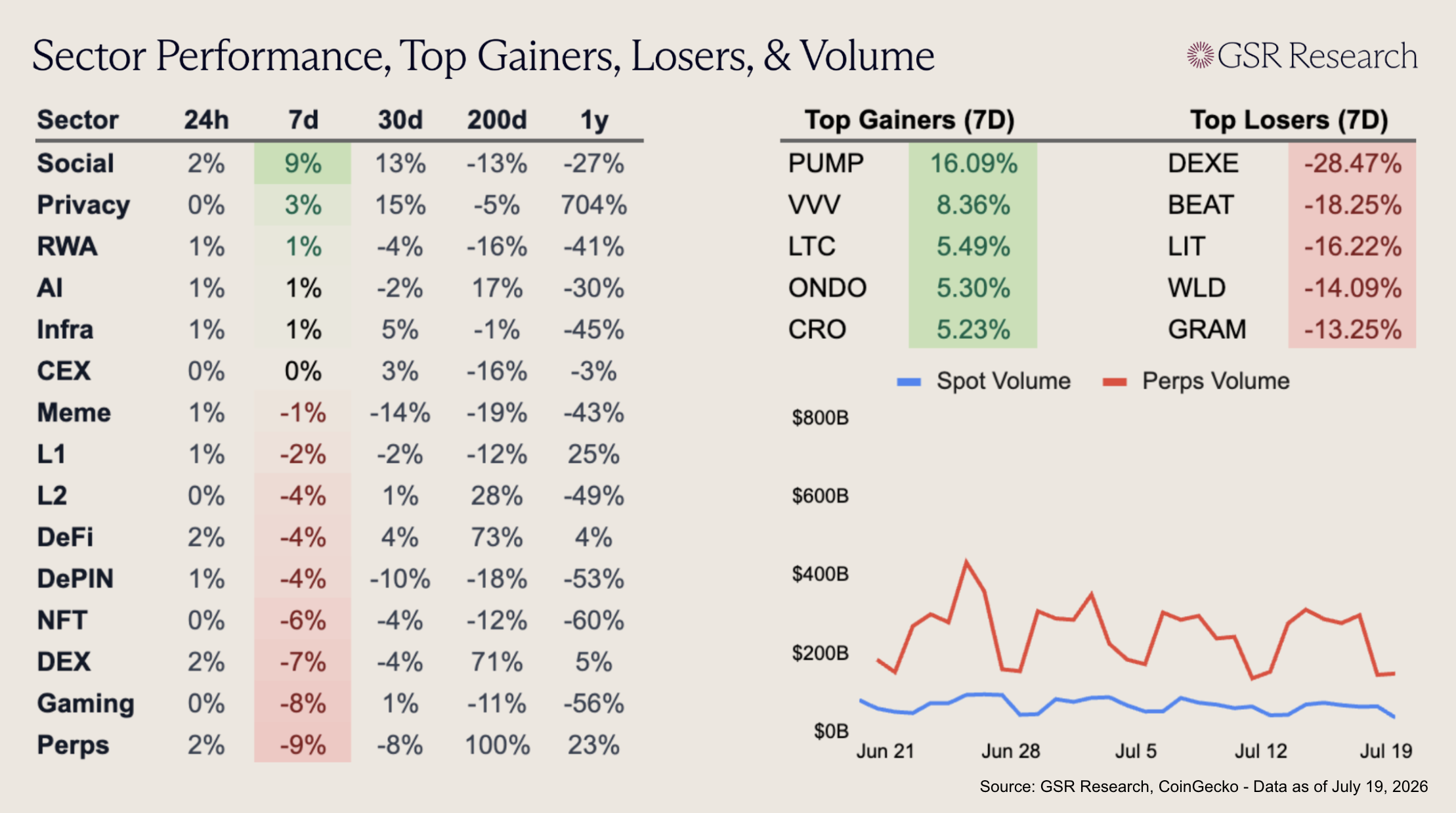
Most sectors finished lower this week, with Social the clear outlier, up 9%. Social strength came from PUMP (+16.09%), which rallied as renewed memecoin activity lifted launchpad volumes, holder count hit a record, and Sunday's viral Jimothy launch drove platform activity into the close. Privacy added 3% as ZEC firmed into Zcash's Ironwood activation, now set for July 28 after a one-week delay. VVV (+8.36%) lifted AI after Venice began directing API subscription revenue to recurring buybacks and burns, a direct answer to the value-accrual concerns behind last week's selloff, while ONDO (+5.30%) carried RWA higher after launching tokenized stocks backed by DTC entitlements and announcing a Japan tokenization push with SBI.
The loser board was once again a list of recent leaders giving back their runs, with Perps (-9%), Gaming (-8%), and DEX (-7%) the biggest sector laggards. Perps and Gaming weakness came from LIT (-16.22%), which gave back the rally that followed its first revenue-funded burn and Robinhood Chain integration, and BEAT (-18.25%), which cooled after its parabolic buyback-and-burn run left it at its most overbought levels on record. DEX was almost entirely a HYPE (-10.13%) story given the token's roughly 65% weight in the sector, as wallets suspected to be linked to a16z moved roughly $59m to exchanges and futures longs unwound despite platform open interest hitting a 2026 high, with AERO (-13.59%) adding to the weakness. DeFi slipped 4% as DEXE (-28.47%), the week's biggest loser, retraced from its July 13 record after a listing-driven short squeeze exhausted itself, with thin exchange liquidity amplifying the move lower.
This material is provided by GSR (the “Firm”) solely for informational purposes. It is not intended to be advice or a recommendation to buy, sell or hold any investment mentioned. Investors should form their own views in relation to any proposed investment.
It is intended only for sophisticated, institutional investors and does not constitute an offer or commitment, a solicitation of an offer or commitment, or any advice or recommendation, to enter into or conclude any transaction (whether on the terms shown or otherwise), or to provide investment services in any state or country where such an offer or solicitation or provision would be illegal. The Firm is not and does not act as an advisor or fiduciary in providing this material.
This material is not an independent research report, and has not been prepared in accordance with any legal requirements by any regulator (including the FCA, FINRA or CFTC) designed to promote the independence of investment research.
This material is not independent of the Firm’s proprietary interests, which may conflict with the interests of any counterparty of the Firm. The Firm may trade investments discussed in this material for its own account, may trade contrary to the views expressed in this material, and may have positions in other related instruments. The Firm is not subject to any prohibition on dealing ahead of the dissemination of this material.
Information contained herein is based on sources considered to be reliable, but is not guaranteed to be accurate or complete. Any opinions or estimates expressed herein reflect a judgment made by the author(s) as of the date of publication, and are subject to change without notice. The Firm does not plan to update this information.
Trading and investing in digital assets involves significant risks including price volatility and illiquidity and may not be suitable for all investors. The Firm is not liable whatsoever for any direct or consequential loss arising from the use of this material. Copyright of this material belongs to GSR. Neither this material nor any copy thereof may be taken, reproduced or redistributed, directly or indirectly, without prior written permission of GSR.
Please see here for additional Regulatory Legal Notices relevant to US, UK and Singapore.